

Try Weglot for free


Anyone who’s looked into Machine Translation Post-Editing (MTPE) rates will already know that a cost appraisal is more than a little complex! MTPE means a human linguist reviews and corrects a translation that’s first been produced by an AI engine, adding to the traditional machine vs human workflow choice.
Alongside direct cost comparisons of different MTPE methods, you’ll also need to consider your initial machine translation quality, language pairs, and have an idea of how much content you’ll likely need to translate as your site grows. Frame your situation with these variables and those wildly different quotes will suddenly start to make more sense.
This article breaks down the main translation methods available, the real cost drivers behind them, and how to make the right decision for your brand. By the end you’ll know the most cost-effective solution, and be able to go multilingual with a clear projection of your future budget.
Machine translation post editing combines two approaches:

Raw AI translation gets you far, but it can miss cultural nuances or brand-specific terminology. On the flipside, relying solely on humans for thousands of words is slow and drains your budget. MTPE is a hybrid model that uses AI to do the heavy lifting, then brings in a human expert to ensure the final text doesn’t sound like a robot wrote it.
This approach gives you the speed of a machine with the accountability of a person. You get your content live faster without risking your brand’s reputation on a literal translation error.
When you hire a professional post-editor, you’re choosing a service level that dictates how much of the ‘machine work’ remains in the final text:
LPE is a ‘good enough’ review that ensures comprehensibility and accuracy without perfecting style. The post editing goal is to fix blatant errors and mistranslations while leaving the machine’s structure untouched. It’s best for internal docs, help desk tickets, or high-volume product descriptions.
FPE is a comprehensive review that delivers publication-ready text matching brand voice and nuance. The editor restructures sentences, checks for cultural idioms, and ensures the tone isn't robotic. If it’s for your homepage, for example, you need FPE.
MTPE rates aren’t a single fixed number. They usually fall between 30% and 70% of a standard human translation rate. To benchmark your quotes, look at these three common models:
Fixing nonsensical AI errors can be more mentally draining than writing from scratch, so always look for the most cost-effective option and seek your translator’s opinion. If the initial machine quality is poor, an editor spends more time auditing and correcting than they would just translating. Remember that good work usually takes time.
By using AI to handle the initial draft, you remove the ‘blank page’ problem that slows down traditional workflows:
By contrast, full human translation often delivers high translation quality, but at long timescales and high costs. The MTPE route gives you all the positives found in both approaches. And, bear in mind, most human translators use machine translation as a first base to work on.
To get the best ROI from a hybrid workflow, treat the machine as a teammate! Efficiency starts long before the post-editor opens the file:
A machine can only be as clear as the text you feed it. If your source content is full of complex metaphors, passive voice, or long, rambling sentences, the AI output will be equally confusing.
Don’t assume your editor knows your brand’s specific vibe. Providing a glossary of product names and technical terms prevents expensive re-work.
Not all content requires the same level of care:
Estimating translation costs is rarely as simple as multiplying word count by a flat rate. Consider the following to avoid surprises at invoice time:
As we mentioned, a major hidden variable in MTPE is the quality of the raw AI output. If the machine generates a messy first draft, your human editor has to spend more time auditing and correcting.
As we’ve seen, in some cases, fixing poor machine translation takes longer than translating from scratch, leading agencies to charge 70-100% of their full human rate. Experiment with AI until it ‘understands’ your needs and produces something close to what you’re looking for. This approach will make you huge savings in the long run.

Watch for these additional charges:
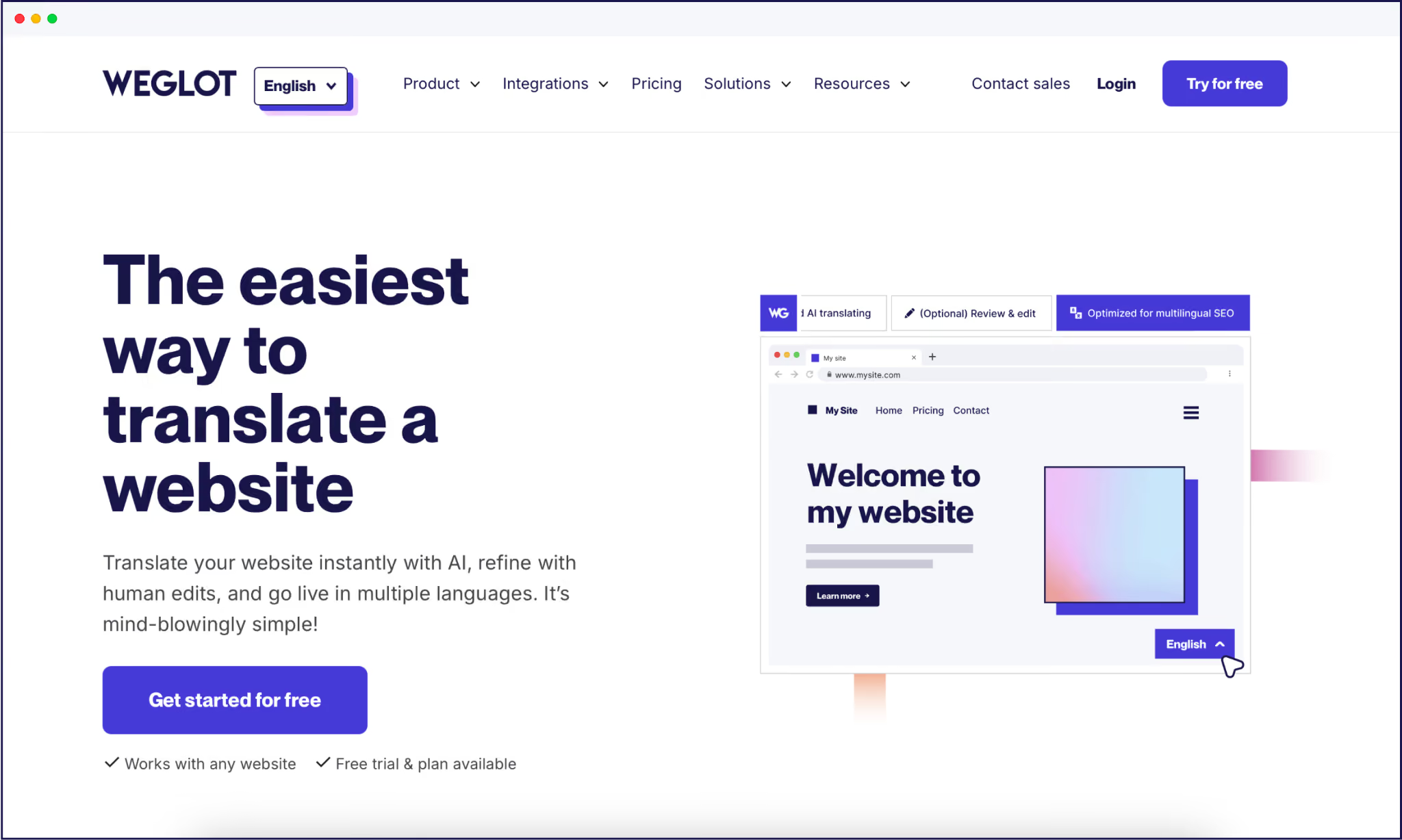
Traditional MTPE can feel like managing a second business. You’re constantly negotiating per-word rates, auditing AI quality, and manually uploading files to different vendors. And it’s up to you to copy/paste native content into Google Translate every time a new page goes live – and set up all of your foreign language pages in a way that search engines understand. We built Weglot to remove such work.
Weglot moves you away from the unpredictability of per-word pricing. Instead of worrying about a surprise invoice for every new blog post or product description, our subscription model covers the technology, hosting, and automatic detection of new content. You get total cost clarity from day one.
For example, our Starter plan translates up to 10,000 words for $170/year – and all this happens in minutes. It’s a much cheaper – and faster – result than paying for full site translation or copy/pasting content into Google Translate. And the combination of machine translation with AI ensures a high-quality, human-like output, meaning the need for professional refinement is greatly reduced.
“While our standard MT translation provides a solid base, our AI Language Model (powered by OpenAI and Gemini) puts quality on autopilot. It learns from your brand guidelines, glossary, and past manual edits to generate translations that already sound like you.”
– Eugène Ernoult, CMO at Weglot
This self-learning loop reduces the need for expensive, full-scale human editing over time. As the model gets smarter, your manual workload – and your costs – drop.
Most enterprise translation workflows take months to integrate, but Weglot does it in less than 10 minutes – and only five if you’re on WordPress. Our tool works with any CMS, comes tech-free, and handles all your multilingual SEO (like hreflang tags) automatically – something that MTPE doesn’t include at all.

Refining translations is also made easy. Admins work from a centralized database, and can give specific page access to translators to review your content.

This can all be done on the frontend through our Visual Editor, so you can ensure your translated content still fits around your existing designs.

The shift to a hybrid approach can make a marked difference to your timescales, budget, and workflows, as our customers will tell you!

REVIEWS.io switched from a clunky manual process to Weglot and saw a 20% increase in conversions and a 120% spike in German traffic.

Similarly, The Bradery manages over 500 new product translations daily with just 10 minutes of review twice a week.
{{quote-image-banner}}
Navigating translation costs doesn’t have to be a guessing game of per-word rates and hidden fees. MTPE is a powerful tool for scaling, but its success depends on having the right platform to manage the complexity. By combining the speed of AI with the precision of human expertise, you can launch into new markets without the traditional enterprise price tags.
Weglot simplifies this entire process. We give you a custom AI Language Model that learns your brand voice, a tech-free setup that works in minutes, and the total editing control you need to ensure every word resonates. You focus on growing your business while we handle the heavy lifting of keeping your global site synchronized.
If you’re ready to start localizing your website without the per-word pricing headache, sign up for your 14-day free Weglot trial today.

We’ll get your first languages live. You decide how far you want to go. Try Weglot for free today.
Trusted by 70,000+ global brands








Weglot is tested and trusted by brands worldwide since 2016. Join them today.


The best way to understand the power of Weglot is to see it for yourself. Test it for free and without any engagement.
A demo website is available in your dashboard if you’re not ready to connect your website yet.


.avif)


