

Try Weglot for free





On the surface, Spain’s new customer service law might look like nothing more than a regulatory update.
But there’s much more to it than that.
It introduces stricter standards around three critical areas: accessibility, response times, and language support. Large companies that sell to consumers in Spain and meet specific criteria must now provide customer service in regional languages such as Catalan, Basque, and Galician on request.
For many businesses, this raises significant operational questions. Support teams have to add new languages without increasing headcount, all while staying compliant without slowing down operations.
In this article, we’ll break down what the law requires and show you how your business can meet the language requirement without unnecessary cost or complexity.
Law details: Law 10/2025 on Customer Services promoted by the Ministry of Social Rights, Consumer Affairs and 2030 Agenda
Effective from: December 2025
Who it applies to:
Main requirements:
Spain updated its customer service legislation to strengthen consumer rights and improve the overall quality of support experiences.
The law primarily impacts large companies with more than 250 employees and an annual turnover of over €50 million. It also targets essential services sectors such as telecommunications, utilities, financial services, transport, and large-scale retail.
Example: Any airline operating commercial flights in Spain must comply, regardless of whether they meet the employee or revenue thresholds, since air transport is classified as an essential service.
Lawmakers approved the changes in late 2025, with implementation rolling into 2026. Companies have 12 months from publication to comply fully.
At a high level, the law focuses on three main goals:
To comply with Spain’s new customer service law, companies must honor those requests. Speaking of the new requirements, Pablo Bustinduy, Minister of Consumer Affairs, said,
“This law gives more power to consumers to assert their rights against companies.”
The law includes several requirements, but three stand out for digital teams and support leaders.
The law raises expectations around how quickly companies respond to customers. Long delays, limited hours, and hard-to-find contact options no longer meet the standard. 95% of support calls must now be answered within 3 minutes.
Example: A national telecom provider receives thousands of daily support calls. Previously, customers often waited 6–10 minutes during peak hours. Under the new law, the company must restructure staffing, call routing, or overflow systems to ensure that almost all calls connect to an agent within 3 minutes.
This new requirement puts pressure on traditional support models that rely on small teams and narrow schedules. Many companies already struggle to keep up with volume.
Spain’s new law restricts systems that force customers through bots, IVR trees, or self-service flows without a clear path to a human. At any point during a support call, customers must be able to speak to a real agent.
Example: To meet the new law’s requirements, an ecommerce brand might add a language switcher on its website, translate key pages like returns and shipping policies, and localize its contact forms and support flow. Automation handles simple customer requests, while more complex issues get escalated to a human agent.
If your support experience relies heavily on chatbots or automated phone systems, ensure customers can reach a real person when they want to.
When a customer requests support in a region with a co-official language, the company must provide it.
Example: A national bank serves customers in Barcelona. If a customer requests service in Catalan, the bank must offer a Catalan-speaking agent, translated written communication, or real-time translation technology.
To operationalize this at scale, the bank might:
This approach allows the bank to meet language requirements while protecting accuracy in high-stakes interactions.
For businesses that operate nationally or serve customers across Spain, this requirement creates immediate challenges. Most support teams operate in Spanish and perhaps English, with very few having in-house capability for multiple regional languages.
Spain’s new customer service law reflects a growing global demand for more human-centered, inclusive, and accessible support experiences.
Customers no longer accept one-size-fits-all service. They demand personalization and expect companies to meet them where they are, in their language, on their preferred channel.
Additionally, EU regulations around digital accessibility, response times, and consumer protection continue to expand. While increased accessibility is undoubtedly a good thing, these new standards present new support challenges for businesses.
Spain joins other European countries in strengthening customer support regulations, reflecting this broader European momentum toward stronger consumer rights.
Ultimately, businesses that build scalable, multilingual support systems now will move faster and more cost-effectively when new regulations arise.
Many support teams already run lean, and hiring dedicated agents for every required language doesn’t scale. Plus, training teams on terminology, tone, and quality adds to the complexity.
You may find yourself facing questions like:
Without a scalable approach, multilingual support can quickly become expensive and fragmented. But there are solutions.
The good news: Multilingual support doesn’t mean you have to create fully separate teams for each language. Or hiring dozens of new agents or creating complex manual workflows.
AI-powered translation technology changes what’s possible.
Instead of expanding support teams, consider combining AI translation with human oversight. AI handles speed and coverage while your team reviews key content to maintain accuracy, tone, and brand voice.
Adopting this hybrid approach allows you to support more languages without greatly expanding or sacrificing translation quality.
When you pair localization automation with human input, you’re able to meet Spain’s language requirements in a scalable, cost-effective way without overwhelming your support operations.
AI-powered translation tools can instantly translate:
This reduces reliance on bilingual agents and eliminates the need to copy, paste, and manage translations manually.
The reality is that speed matters in website localization. Customers expect to find information in their language immediately. Fast, automated website translation allows you to launch new languages quickly and easily keep content up to date.
Consistency is also essential. AI-powered website localization tools help you maintain consistent terminology, tone, and brand voice across every page.
Weglot’s AI Language Model leverages artificial intelligence so you can automatically translate any website.
The result? You add new languages in minutes, centralize translation, and ensure your website visitors automatically see the most relevant localized version of the site.
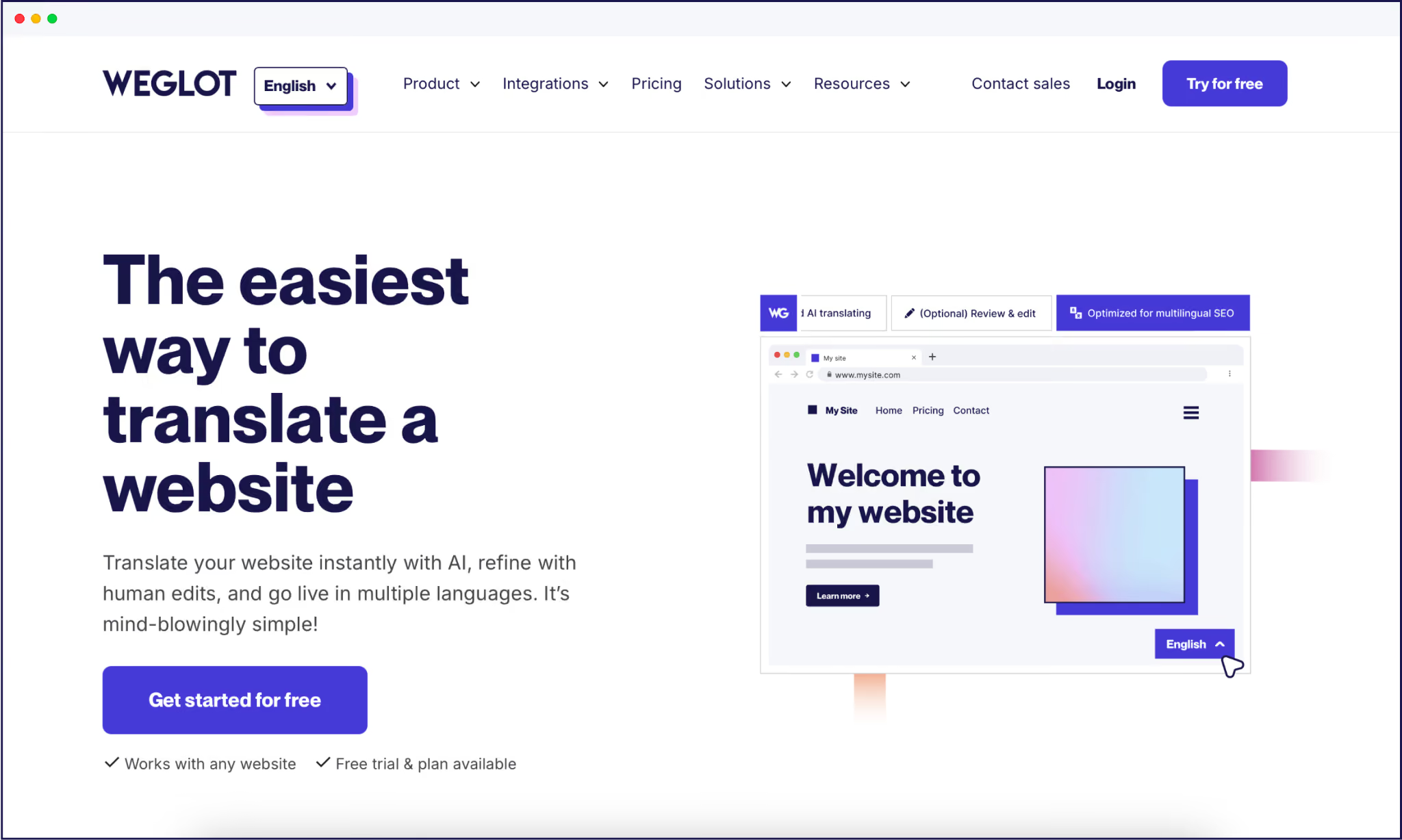
Expanding your website into multiple languages doesn’t mean giving up control over quality. You don’t have to choose between moving fast and staying on-brand.
You can use automation for speed and human editing when it really counts, especially on high-impact pages like pricing, product descriptions, or legal content.
For example, with Weglot, you can create your own custom AI Language Model and brand tone rules to lock in your preferred terminology, product names, and voice. That ensures your brand sounds like you in every language, instead of drifting into inconsistent or awkward phrasing.
Additionally, the Visual Editor reviews translations directly on the live website, making it easier to catch issues before customers see them. Weglot also offers translation management controls and page-level exclusions, so you can fine-tune what gets translated and how.
With set-and-forget workflows, your site stays up to date without creating a constant stream of manual work.
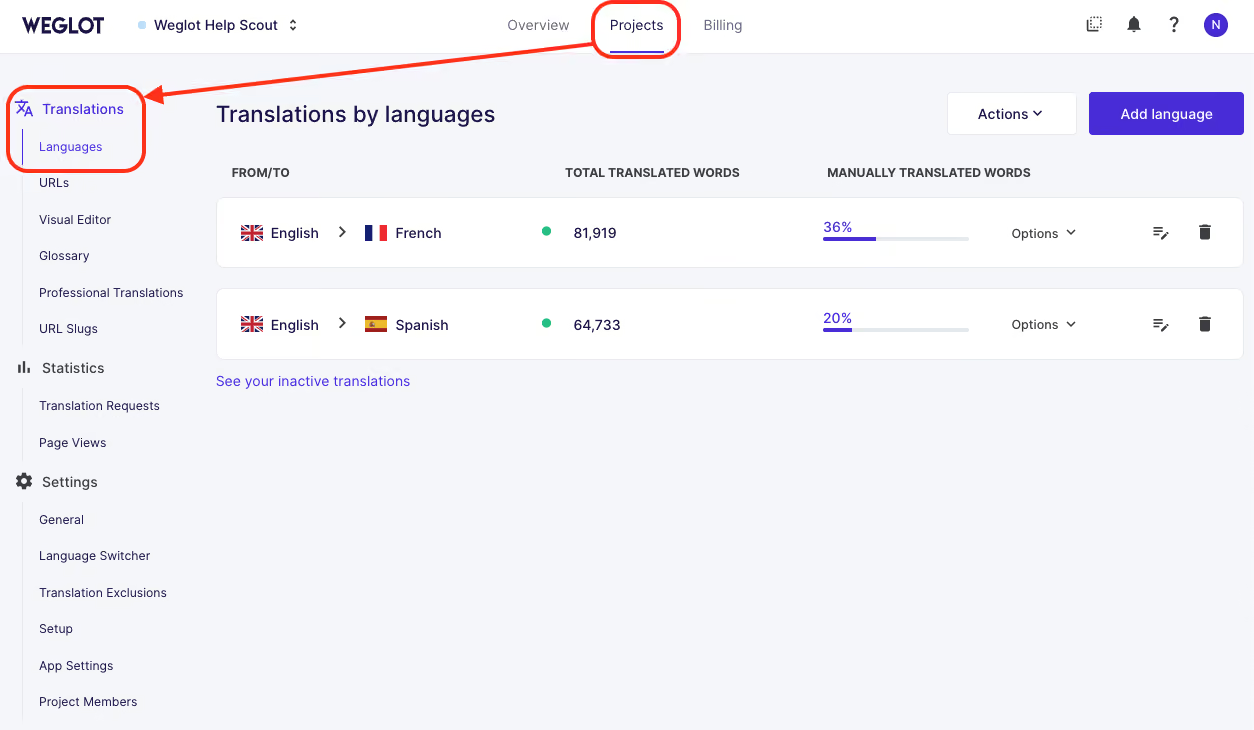
In other words, you scale your website into multiple languages without turning translation into a full-time job.
For many customers, your website is the first place they go for support.
They look for answers before submitting a ticket, browsing help articles, or contacting a live agent. If they can’t find what they need in their language, they’ll escalate the issue to your support team.
If a customer in Catalonia lands on your site and only sees Spanish or English, you create friction right away.
If key pages, FAQs, or help content aren’t available in Catalan, visitors may abandon the site.
A multilingual website helps reduce that friction. Localized pages make information easier to find. Translated FAQs and help content answer common questions upfront.
Weglot makes it easy to build a multilingual website or translate your existing one without rebuilding your site or workflows.

You can launch new languages quickly, manage translations in one place, and ensure visitors automatically see the most relevant version of the site.
You don’t need a massive transformation plan to meet Spain’s new requirements. You just need a scalable way to make your website work across languages.
Start by identifying which regional languages matter most for your audience. Look at where your customers come from and where Catalan, Basque, or Galician requests are most likely to appear.
Next, review your website from a customer’s perspective. Check your:
Ask a simple question: Can customers find what they need in their preferred language without contacting support?
From there, pinpoint the biggest gaps. Your website may only exist in Spanish or English. Perhaps your help content hasn’t been localized. And important conversion pages aren’t accessible in regional languages.
Once you’ve identified those gaps, focus on scaling website translation first.
Over time, track how visitors interact with your localized content. Look at engagement, bounce rates, and support volume by language. Use that data to refine your pages and expand localization where it has the strongest impact.
When you start with your website, you can make meaningful progress toward compliance without overwhelming your support team.
Complying with Spain’s new customer service law may feel daunting at first. But with the right approach, it becomes manageable and scalable.
Multilingual, accessible support doesn’t have to mean higher costs or more complexity. With tools like Weglot, you can meet regulatory requirements while also improving your customer experience.
If you’ve been impacted by Spain’s new customer service law, or want to stay ahead of similar regulations, Weglot will help you translate and manage your website at scale without adding operational complexity.
Weglot powers 110,000+ multilingual websites worldwide and earns consistently high ratings on G2 for ease of use and reliability. Explore how it can help you launch and manage multilingual website experiences with confidence through Weglot’s 14-day free trial.

We’ll get your first languages live. You decide how far you want to go. Try Weglot for free today.
Trusted by 70,000+ global brands





Weglot is tested and trusted by brands worldwide since 2016. Join them today.


The best way to understand the power of Weglot is to see it for yourself. Test it for free and without any engagement.
A demo website is available in your dashboard if you’re not ready to connect your website yet.


