Try Weglot for free


Going international is one of those milestones that looks achievable on a roadmap. Although you can identify a target market, map the languages, and plan the entry, you might not see the scale of work involved once you commit.
The biggest operational challenges that can derail your global expansion aren't the visible, strategic ones. Instead, it's the technical layers not built for multiple languages, content processes that can't keep pace, and brand voicing that drifts depending on who's translating it. However, for all of the challenges you can face, Weglot is practically the only translation platform that can solve them.
There's a difference between testing a new market and committing to one. While running a campaign in a new country tells you whether demand exists, committing means you build that infrastructure to serve the market over time.
This includes translated content, a technical layer that handles multiple languages, a team that understands local customers, and processes that can sustain it all. Each additional market will multiply the workload because every change, update, or campaign now has to mirror across each language version.
Unfortunately, very little of your home market 'playbook' will transfer. The tone, messaging, channel mix, and SEO approach that performs at home may not reflect what customers in a new market search for, trust, or respond to.
The other thing that matters is getting the architecture right before you launch. Your URL structure, hreflang tags, metadata translation, content queuing all set the conditions for everything that follows.
What's more, 'retrofitting' mid-expansion is a different situation. URL structure changes require redirects that risk breaking indexed pages. Hreflang errors that have been live for months create duplicates that affect indexing across your entire site. Getting ahead of that is always cheaper than catching up.
Most teams encounter the same set of challenges on the path to international growth. The six below may be a lot, but some are only visible after you launch.
Understanding each one, what causes it, and what the fix looks like is how you go from an expansion plan that looks right on paper to one that holds up in reality.
Checking for demand in a market is a good start on international expansion, but your research needs to go further. At a minimum, you need to understand local search behavior, cultural norms, buyer expectations, how competitors are positioned, and what the regulatory environment looks like.
The difficulty is that most of the gaps only become obvious once you're operating inside a market. You can benchmark from a distance, but the nuances of how customers phrase their needs, what builds trust, and what doesn't resonate are things you learn by being there.
For example, what people search for in one language often has no direct keyword equivalent in another. Building on translated keywords rather than locally researched ones is a common multilingual SEO mistake.
Before you commit, you can look at three research areas to tell you whether your assumptions hold up:
This research ultimately shapes the content strategy, messaging, and translation approach you'll use once you're in the market.
Language barriers create two separate problems. The first is discovery: if your website doesn't exist in the local language, it won't rank for the searches your potential customers run. The second is that an English-only experience signals you haven't built for your audience.
According to our multilingual website research, three-quarters of customers prefer to purchase from a site that offers information in their own language. Most rarely or never buy from English-only websites. A site generating traffic from non-English markets (but isn't converting) is spending with no return.
Language alone isn't the full picture, though. Communicating in the local language doesn't automatically mean communicating well. Tone, cultural associations, and register vary by market:
This is why your multilingual infrastructure needs to be in place before you enter a market. If you launch without a translated site, every day you're live means potential customers could find you, see an experience that wasn't built for them, and leave. The low conversions and high bounce rates you'll see in that window will look like the market isn't viable when the real problem is your site.
Brand fragmentation happens when different language versions of your website start to communicate differently from one another. This could be in headlines that sound like a different company wrote them, CTAs that shift in formality from page to page, and product descriptions that read as mechanical, awkward translations rather than on-brand copy.
The causes are usually structural:
All of this combined erodes trust. When a customer encounters you across the web and the voice shifts, the experience will come across as unpolished. In markets where you're building credibility for the first time, this matters.
The fix requires three things working together. First, document brand principles at a level of specificity teams can act on. This means example sentences, approved terminology, and explanations for why certain phrases work and others don't, per language if needed.
Next, lock shared terminology in a glossary so product names, CTAs, and brand phrases stay consistent across all language versions. Once you have these in place, build a review process based on content weight instead of volume. High-traffic pages, key conversion paths, and onboarding content carry more brand risk than a rarely-visited page, so prioritize them first.
Behind every translated page on a multilingual website is a technical layer that tells search engines what language it's in, who it's for, and how it relates to the other versions of the same page.
This includes choosing between subdirectory and subdomain URL structures, implementing hreflang tags, translating metadata, building multilingual sitemaps, and handling dynamic content. Each of these is a potential failure point:
In addition, every new piece of content you add for a language creates a gap in the others. On a site publishing blog posts, product pages, or campaign landing pages, those gaps widen quickly unless something closes them automatically.
If you're configuring all of this by hand, the workload adds up. What's more, it's going to take time to diagnose and fix anything that will inevitably break, which becomes a maintenance commitment that competes with your other priorities.
{{tools-banner}}
Weglot's Hreflang Checker can help through auditing your implementation and flagging errors:
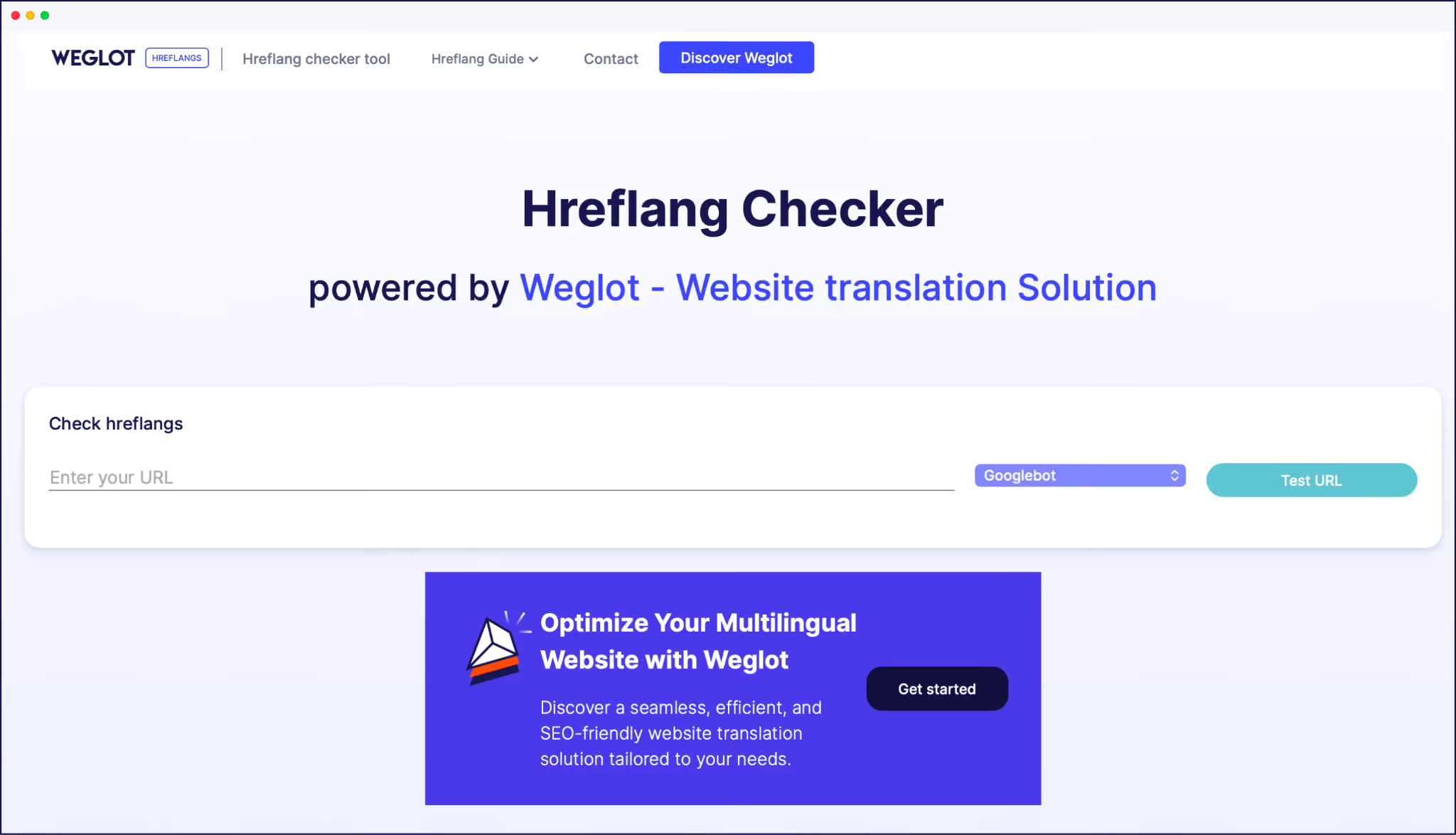
However, for more granular work, Weglot can handle hreflang generation, metadata translation, and URL structure from the moment you install it. We'll talk about this more shortly.
A growing site will create backlogs fast, such as product updates, blog posts, campaign landing pages, and seasonal content. This will all need to go live in every active language. So, when one market publishes a feature page or refreshes a campaign, every other language version needs to catch up.
Until it does, those markets are running on an incomplete version of your site. Customers browsing in their own language will see gaps, which affects their experience. A manual translation workflow can struggle at this point, especially when your publishing velocity increases, and you'll often see one or more consequences:
Many companies respond through going live with just the core pages and planning to catch up later. In practice, this rarely works because markets that launch incomplete tend to stay that way. When a workflow requires a manual trigger for every piece of new content, the process itself becomes the bottleneck.
How you structure your content team for international markets determines how fast you can move, how consistently your brand shows up, and whether your translated content resonates with local audiences.
A centralized team can be more productive and consistent, but carry the bias of the home market. Local teams understand the culture and the customer, but can sometimes diverge from the brand without guardrails.
There's a tension here that tends to produce one of two outcomes:
An ideal model will combine centralized yet shared brand principles with local market-level expression. The central team will set the guardrails through tone, terminology, and key claims, while the local teams make decisions such as a formal versus informal register, which imagery resonates, and how product functionality maps to local buyer expectations.
If you manage translations through freelancers or agencies, the same principle applies. Glossaries, style guides written at an actionable level of specificity, and a review process concentrated on high-stakes content should reduce the need for later corrections.
From the six challenges, language accessibility, brand consistency, technical infrastructure, and content velocity all share a common thread. They're all problems that happen on your website, or get worse because of what your website doesn't do.
To address this, Weglot connects to your site and translates all content at the rendered output level. It detects product pages, blog posts, metadata, dynamic elements – every piece of content – as a single translation project rather than gaps you discover later. Then, it displays it lives for you in multiple languages.
For AI search visibility, our research from analyzing 1.3 million citations across Google AI Overviews and ChatGPT found that translated websites gain three-times more visibility in AI-powered results compared to single-language sites.
For example, The Bradery translates over 500 product launches per day on autopilot. Bigblue cut the time spent on new page translations to a third of what it previously took.
{{quote-cta-banner}}
Essentially, your entire site becomes multilingual from the moment you install Weglot. It translates all your content from a choice of more than 110 languages, while detecting and queuing new pages and content updates automatically. You can find all of this content within the Translation List, where you have full scope to edit them further:

For greater accuracy and refinement, the AI Translation Model learns from your brand description, tone of voice instructions, and glossary to apply your brand parameters from the first translation run. It improves from your manual edits over time, which should cut down on further changes or incorrect translations from the start.

However, rather than working through a spreadsheet of strings, the Visual Editor lets you see your translated site as your visitors do and make edits in context:

Finally, on a technical level, language-specific URLs, hreflang tags, translated metadata, and translated sitemaps are all configured at install without developer input. The technical layer also stays current as your site changes. It makes Weglot almost a 'set-and-forget' system, especially for initial translations and management.
International expansion is rarely derailed by a single issue, but by the combined effect of structural gaps in your technical layer, content process, brand governance, and team coordination. The challenges in this post won't arrive in sequence. Instead, they layer on top of each other and those you don't address early become harder to fix later.
If you're currently at the planning stage, the priority is getting your market research, technical infrastructure, and content process right before you launch. If you're already operating across markets, the fastest path forward is addressing the digital layer first as this provides the most benefits.
For most of the challenges you'll face with global expansion, Weglot removes the overheads. With a 14-day free trial you can see your site in a new language in minutes.

We’ll get your first languages live. You decide how far you want to go. Try Weglot for free today.
Trusted by 110,000+ global brands








Weglot is tested and trusted by brands worldwide since 2016. Join them today.


The best way to understand the power of Weglot is to see it for yourself. Test it for free and without any engagement.
A demo website is available in your dashboard if you’re not ready to connect your website yet.


With Weglot, the initial translation of an existing site can go live in under an hour. How long it takes to reach a quality level you're comfortable with depends on how well your AI Translation Model is configured and how much content needs human review.
Launching without hreflang tags is the most common and untranslated metadata is second. Both are handled automatically by Weglot. However, you can audit your current setup using the free Hreflang Checker.
When you publish or update content, Weglot detects the change and queues it for translation automatically. Your AI Translation Model applies your brand parameters to new content, while you review translations through the Translation List or Visual Editor.