Try Weglot for free




This is a new study in our series of investigating AI behavior in multilingual markets.
For a very long time, and much to the dismay of academic professionals (can anyone still hear “NO USING WIKIPEDIA” ringing in the back of their head?), Wikipedia has been treated as the default knowledge source. It's open, structured, and even better – multilingual, and constantly updated. Which, on paper, also makes it the perfect citation candidate for large language models (LLMs).
Which is why, along with Reddit, it’s one of the most influential sources on LLMs. But given the crowdsourced nature of Wikipedia, it’s susceptible to having negative or outdated information edited in, which can also make its way into AI search.
So it’s no surprise that the common assumption is that Wikipedia has shaped the GEO landscape. Optimize for what Wikipedia covers, get cited where Wikipedia is cited.
But our data tells a different story.
We already know that not translating your website means you’re invisible. But does having a company Wikipedia page shift things in your favor?
We looked into how often the three leading AI models cite Wikipedia, in which languages, and what they cite instead. The results challenge the Wikipedia-is-king perception, and reveal something more useful for any brand thinking about AI visibility in international markets: LLMs are actively hunting for high-authority, natively translated sources. When they find them, they cite them. When they don't, they fall back to English.
We analyzed how Claude Haiku 4.5, Gemini 3.1 Flash, and GPT 5.4 Mini cite sources across 750 queries.
The queries were built from 15 Wikipedia pages per language combination: English-only topics, French-English, Spanish-English, and Japanese-English. Five queries were generated per page, then English-only queries were translated into the three target languages to test how citation behavior shifts when the same question is asked in a different tongue. That came out to 750 prompts in total, which were each run through all 3 models, giving us 2,250 individual model responses to analyze.
Every prompt explicitly asked the model to provide cited source URLs and to flag when it was answering from its own knowledge instead. The model responses were then matched against the relevant Wikipedia domain (English or target-language) to measure how often Wikipedia itself was cited, and which domains showed up in its place.
Note: in early testing, Claude was answering English queries from its own training data without surfacing sources. The prompts were adjusted to explicitly request citations across all models. Even after that adjustment, Claude continued to flag "own knowledge" responses at unusually high rates on English-only topics, which we'll get to.
We came into this assuming Wikipedia would come out on top, but the data flat out said otherwise.
Across the majority of topics tested, Encyclopaedia Britannica was the single most cited domain, with 1,164 total citations across all three models. English Wikipedia came in second with 433 general citations – a pithy ⅓ of Britannica’s.
The only category where Wikipedia won was highly specific, English-only niche topics, where it overtook every other source. Everywhere else, Britannica dominated.
Britannica's centralized domain strategy is doing the work here. Unlike Wikipedia, which splits content across language-specific subdomains (fr.wikipedia.org, es.wikipedia.org, ja.wikipedia.org), Britannica concentrates almost all of its content on britannica.com and serves primarily English pages. That single high-authority domain accumulates link equity, citation weight, and AI trust signals that Wikipedia's distributed model potentially fragments by design.
Based on these findings, domain authority concentration appears to compound in AI citation contexts the same way it compounds in traditional search. If your content lives on one strong domain, it's likelier to surface than if it lives across many smaller ones.
Britannica's English-only approach, while successful, falls steeply in other languages.
When the exact same French-localized topics were queried in English vs. in French, Britannica's citation count plummeted by 55%. In Spanish, the drop was 23%. In Japanese, where the linguistic and cultural distance from English is largest, citations fell by 80%. So yes, their strategy works amazingly in English, but stops there completely.
Britannica still benefits from its sheer domain authority. Even on French and Spanish topics queried in the local language, it remained the most cited domain overall. But the drop-off shows that English-only content faces a hard performance ceiling once users start asking questions in their own language. The same authoritative source loses more than half of its visibility in French, and four-fifths of it in Japanese, because the content isn't available natively.
This gives a crystal-clear argument for why translated content is no longer optional in AI search. English-only sources don't disappear from foreign-language citations entirely; they get systematically deprioritized in favor of local alternatives, and the gap is large enough to be a real visibility cost. It makes sense – users would much rather read content tailormade for them (which is the whole point of localization).
There's a model-level wrinkle here too. Britannica's strength in foreign-language queries depends almost entirely on GPT and Claude continuing to surface English sources. Gemini actively avoids English domains in foreign queries, pivoting to local sites like larousse.fr (32 citations in French) instead.
For the subset of topics that only exist on English Wikipedia, with no translated equivalent, models had to make a choice: refuse to answer, fall back to their own knowledge, or point users back to the English page regardless of the query language (or bridging).
All three models chose to bridge the gap. They cite English Wikipedia at surprisingly stable rates: GPT averages 48.3%, Claude 26.8%, and Gemini 19.8%. What's counterintuitive is that querying in English never produced the highest Wikipedia citation rate.
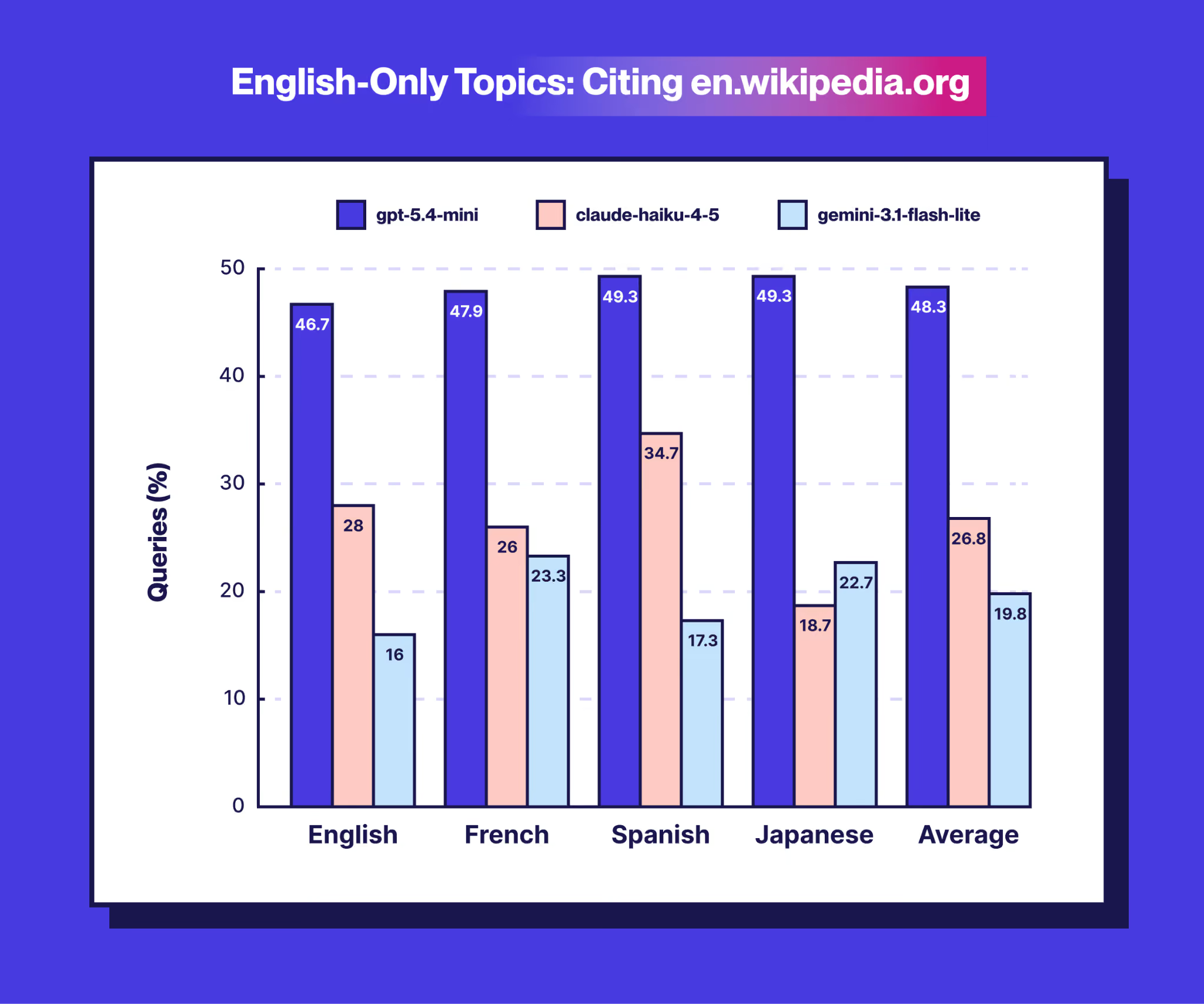
GPT peaked at 49.3% in Spanish and Japanese. Gemini hit 23.3% in French (vs. 16% in English). Claude hit 34.7% in Spanish.
The most plausible explanation is competitive density: when you query in English about a niche English topic, the model has an enormous pool of English-language web content to choose from, and citations get distributed across many sources. When you query in a foreign language about that same niche topic, the model has no localized authority to fall back on, so it points directly to the English Wikipedia page. The narrower the alternative pool, the more reliable Wikipedia becomes as a citation.
So this is what any brand operating in foreign-language markets needs to know: the foreign-language web is less saturated, citations are more concentrated, and being the right localized source carries disproportionate (and advantageous) weight.
Claude exhibited a behavior that GPT and Gemini did not. On the 75 English-only topics tested in English queries, Claude flagged 32 responses (42.7%) as "own knowledge" rather than citing sources. When the same English-only topics were queried in foreign languages, the rate climbed sharply.
We have a few theories: Claude may be more conservative about hallucinating citations than its peers, preferring to point out uncertainty over inventing sources. It may have stronger internal safeguards against producing output formed around citations without verifiable backing. Or it may have a lower threshold for falling back to its training data when localized sources are sparse.
Whatever the underlying reason, the data shows that Claude is a less reliable surface for outbound citations on niche English-only topics, particularly when users query in non-English languages. If you’ve been betting on Claude visibility specifically, this might change your strategy.
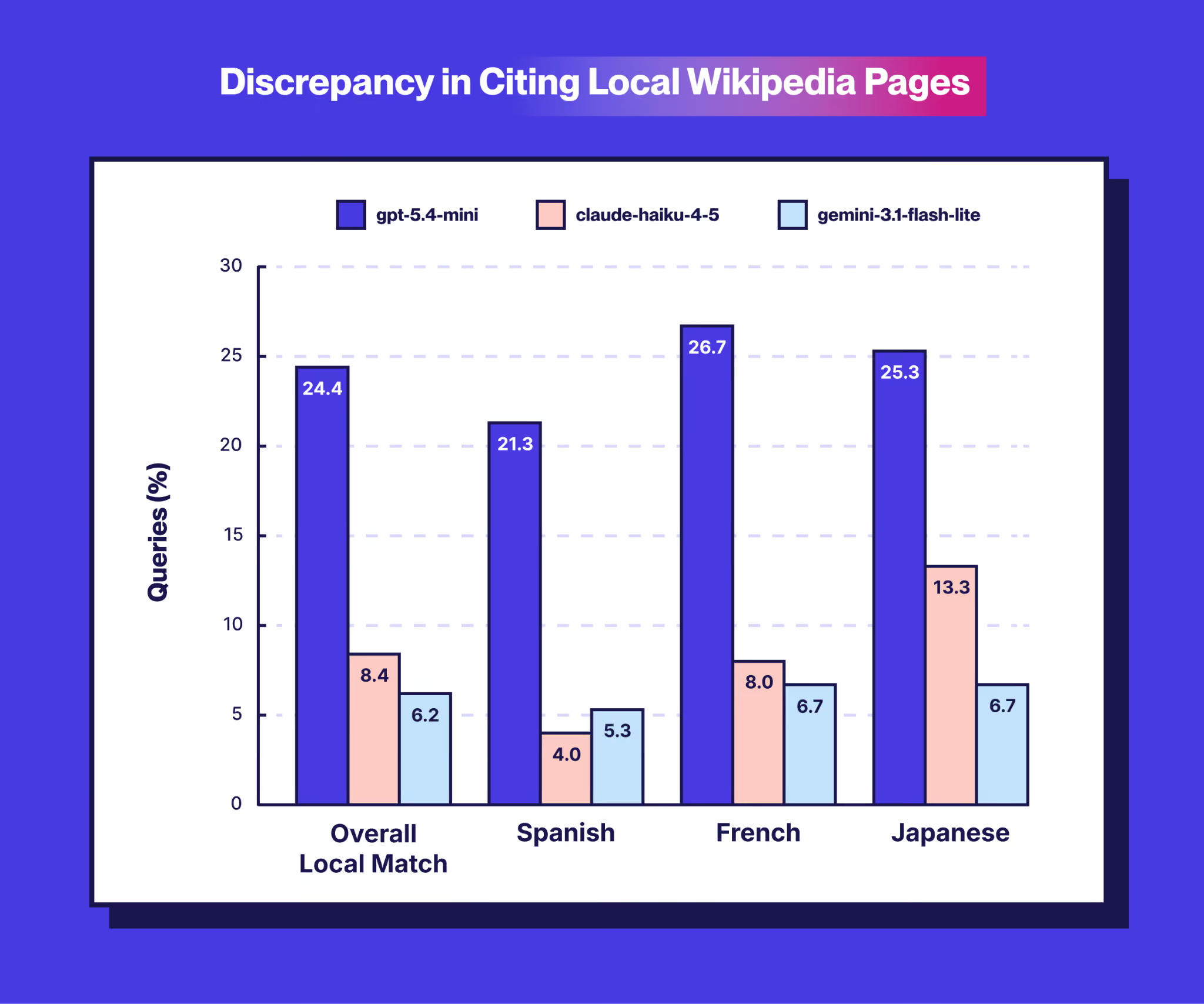
For topics that do have translated Wikipedia pages, models can either cite the localized version (es.wikipedia.org for a Spanish query) or default to English. The choice they make varies dramatically by model.
GPT is, by a wide margin, the most reliable at recognizing and citing the localized Wikipedia version. It does so roughly a quarter of the time. Claude and Gemini barely cite local Wikipedia pages at all, sitting at single-digit rates.
However, it’s worth noting that Claude and Gemini aren't ignoring local content. Instead, they're allocating that citation share elsewhere, toward localized institutional sources. Which shows that local always beats the competition when it comes to serving information.
You might think that when AI models answer questions in a native language, especially those largely trained on English datasets, they're simply translating queries and returning the same global sources. But based on our research, they instead shift their citation behavior toward high-authority local platforms, often institutional ones.
The Louvre (louvre.fr) was cited 39 times. Château de Versailles received 29 citations. Larousse, the French encyclopedia, picked up 66 citations and became Gemini's top source for French topics. Histoire-France collected 24.
The Prado Museum (museodelprado.es) was cited 24 times. UNESCO's World Heritage portal received 36 citations. Cervantes Virtual (a digital library of Spanish literature) received 26. Biografías y Vidas, a Spanish-language biography database, got 24.
The National Diet Library (ndl.go.jp) received 45 citations. NHK, Japan's national public broadcaster, was cited 40 times. Studio Ghibli's official site collected 37 citations on relevant topics. Kotobank, a Japanese reference aggregator, got 22.
For comparison: the Met (metmuseum.org) was cited 117 times in English queries. The National Park Service (nps.gov) received 34. The Pennsylvania Game Commission (pgc.pa.gov) was cited 34 times across English-only niche topics.
The pattern is consistent. AI models prefer culturally and linguistically native institutional sources when they exist. Museums, libraries, public broadcasters, government portals, and reference encyclopedias all outperform global brands and English-only competitors in their native markets.
When you break citations down by TLD (.fr, .es, .jp vs. global/English domains), one model stands out for actively prioritizing local domains.
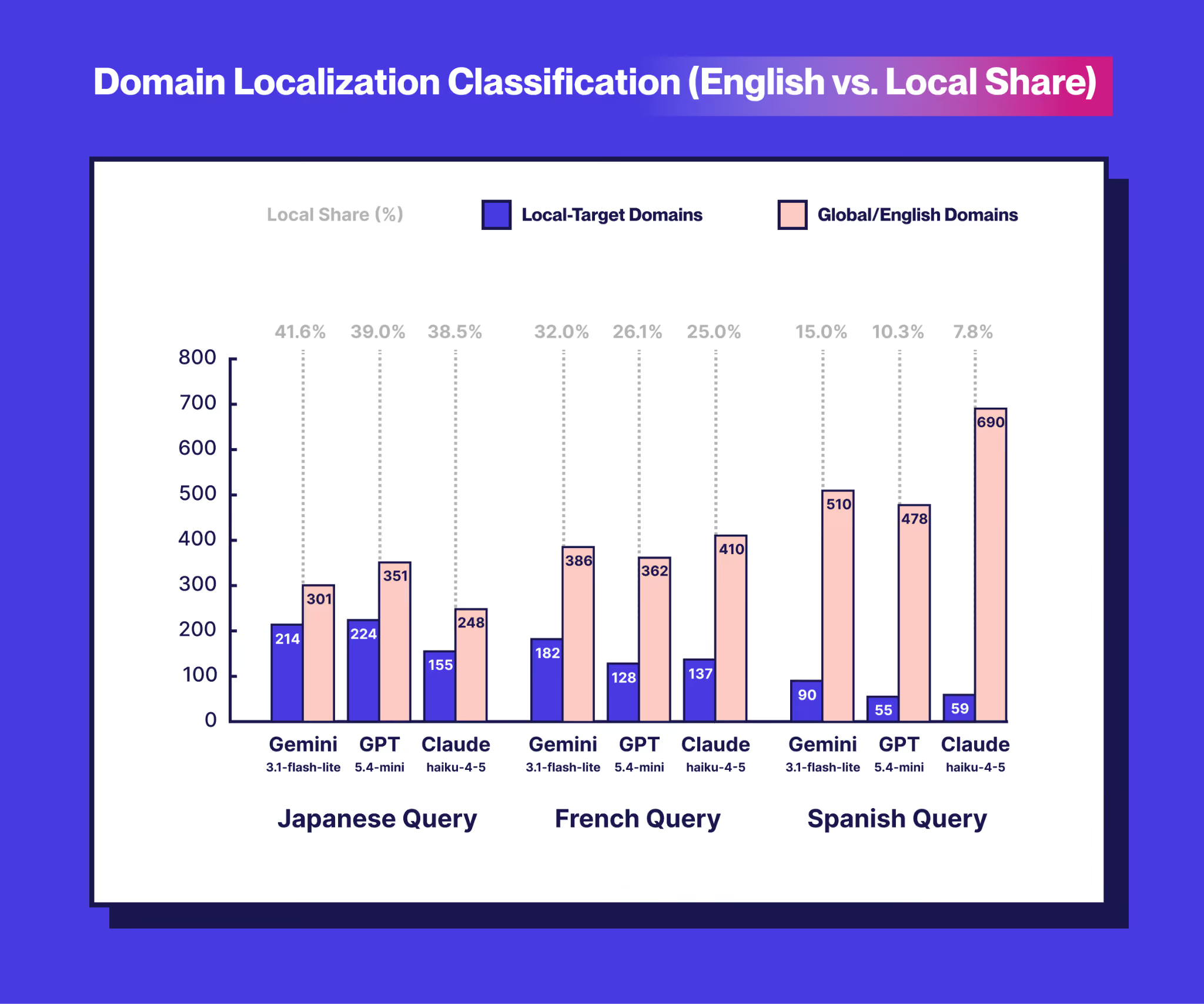
Gemini consistently allocates the largest share of its citations to local-TLD domains across every language tested. This aligns with Gemini's behavior on Britannica too: it's the model most willing to skip English authority domains in favor of localized alternatives.
This matters operationally for brands building international AI visibility strategies. If your priority is Gemini visibility in foreign markets, having a localized version of your site on the appropriate ccTLD (or with proper hreflang signals and translated content) is doing more work than getting cited by Britannica or Wikipedia would.
Here are the biggest takeaways from the study:
Wikipedia isn't the citation monolith people assume (like we did). Britannica's centralized strategy outperforms Wikipedia's distributed one across most topics, and localized institutional sources outperform both in their native markets. If your AI visibility strategy is anchored around Wikipedia, it's probably anchored to the wrong source.
An English-only content strategy has a measurable AI visibility cost in foreign markets. Britannica's 55% drop in French and 80% drop in Japanese aren't outliers. They're a clean demonstration of what happens to any organization that doesn't translate its content: when users query in their own language, the AI looks for native sources first, and English alternatives only fill the gap when nothing local exists.
Local content gets massively rewarded. Because the foreign-language web is less saturated, being the right localized source carries far more citation weight than being the same source in English. The Met receives 117 citations in English topics; the Louvre receives 39 in French. The raw volume looks smaller, but the share of available citation slots in French is much higher, and the competition is thinner.
Translation is now an AI visibility play, not only a localization one. AI models are actively hunting for high-authority, natively translated platforms to serve as their primary citation sources in local markets. Brands that translate their content into the languages of their target audiences are positioning themselves for citations that English-only competitors literally cannot earn. Multilingual SEO best practices, hreflang implementation, language-specific URLs, translated metadata, all of it compounds.
Most AI visibility tools out there account for only English queries, which, as we’ve seen, represents a small slice of the pie. You’d want to track how your brand is talked about in different languages – and luckily, that’s possible with Weglot Radar.
Model behavior is not uniform. GPT bridges to English Wikipedia most aggressively. Claude is the most cautious with citation surfacing on niche English-only topics. Gemini hunts hardest for local-TLD domains. If you're optimizing for one model, your strategy looks different than if you're optimizing for another.
The broader signal is that AI visibility in international markets is being built on the same foundations that have always supported strong organic visibility: authoritative content, properly localized, served from a domain users and crawlers can trust. The mechanism just rewards it more sharply now, and punishes the absence of it more sharply too.
This entire study can be easily summarized into: translate your site, show up where your foreign audiences are. Even though AI has massively changed search and consumption habits, speaking your customers’ language – and owning how you speak to them, rather than leaving it up to browser extensions – is an easy yet sustainable way to reach them.
Ready to get started? Translate your site with Weglot, free for 14 days.

We’ll get your first languages live. You decide how far you want to go. Try Weglot for free today.
Trusted by 110,000+ global brands





Weglot is tested and trusted by brands worldwide since 2016. Join them today.


The best way to understand the power of Weglot is to see it for yourself. Test it for free and without any engagement.
A demo website is available in your dashboard if you’re not ready to connect your website yet.


Language coverage will make the biggest difference. AI search engines prioritize sources that match the query's language, so content that only exists in English rarely gets cited in other languages; in our analysis of 1.3 million citations, translated websites gained 327% more visibility in AI Overviews than single-language sites.
Then make each language version easy to retrieve and cite: give it a dedicated URL, hreflang tags, and translated metadata, and keep translations in sync as your content evolves. Weglot handles that technical layer automatically.
For the full 5-step process, read our multilingual GEO guide.
Yes. In our study, asking the same question in a local language rather than English shifted a large share of citations toward local, in-language domains, most dramatically in Japanese.