

Try Weglot for free


Search has changed. If you're a marketing manager still optimizing purely for traditional rankings, you're solving yesterday's problem.
With Google's AI Overviews now appearing across markets and tools like ChatGPT and Perplexity becoming go-to research platforms, a new question has emerged: when users search in different languages, which websites do AI systems actually cite?
We spent months researching this question: analyzing over 1.3 million citations across AI Overviews and ChatGPT, running comparative studies across Google's AI Mode and AI Overviews, and testing how user location influences citation behavior. The findings are clear, and they have significant implications for any brand targeting international audiences.
In short: untranslated websites are essentially invisible to AI search in languages they don't support. You can find all our studies in our multilingual GEO hub, but stay for a bit – there's more nuance to unpack.
Our flagship study analyzed how AI Overviews and ChatGPT treat translated versus untranslated content, focusing on Spanish-language markets in Spain and Mexico.
In the first phase, we examined 153 high-traffic websites without English translations. The results confirmed our hypothesis: untranslated sites lose significant visibility for queries in other languages, even when they rank well in their primary language.
The numbers are stark. Untranslated Spanish sites in our sample achieved 17,094 citations for Spanish queries in AI Overviews, but only 2,810 for the same queries in English. That's a 431% gap.
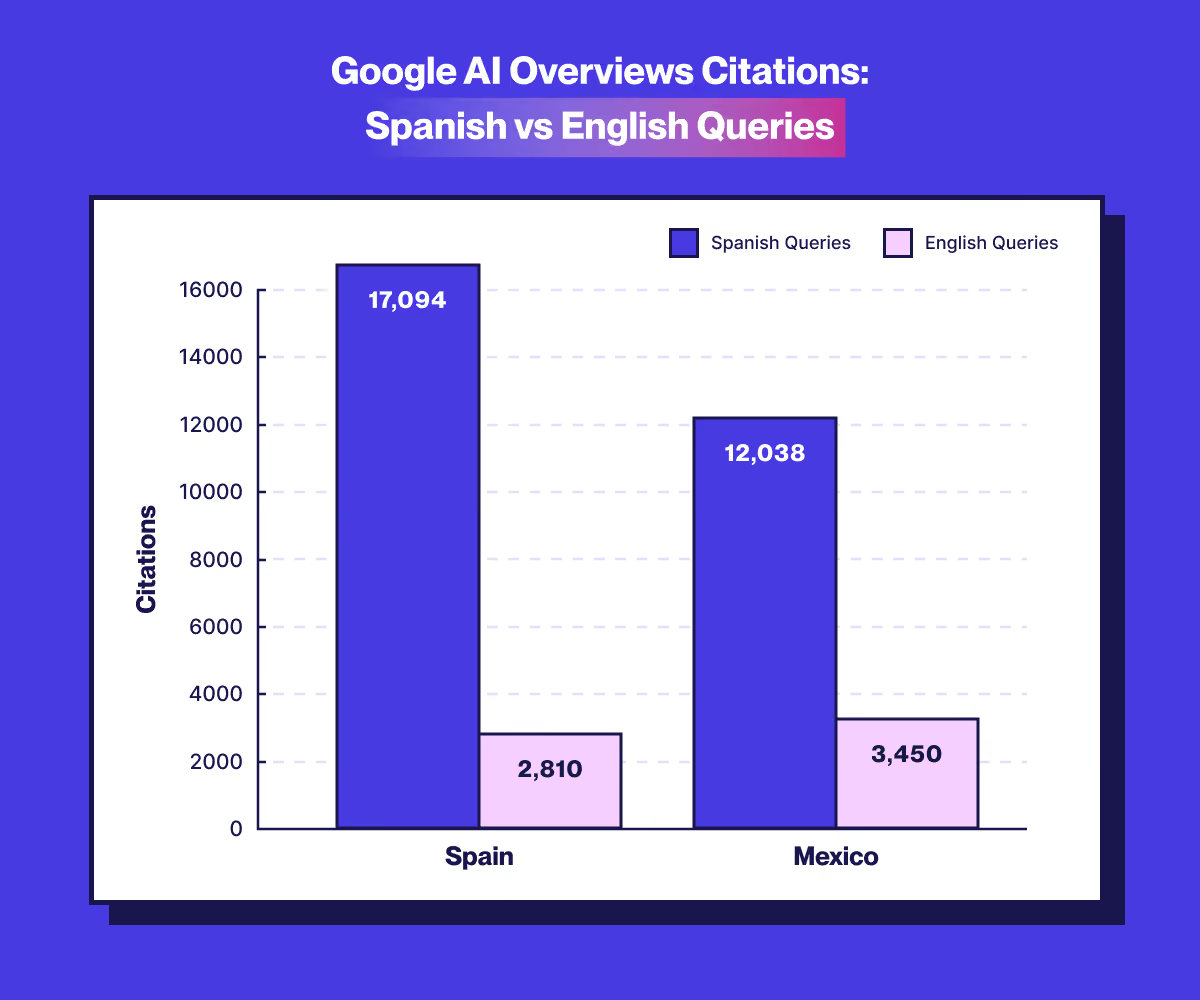
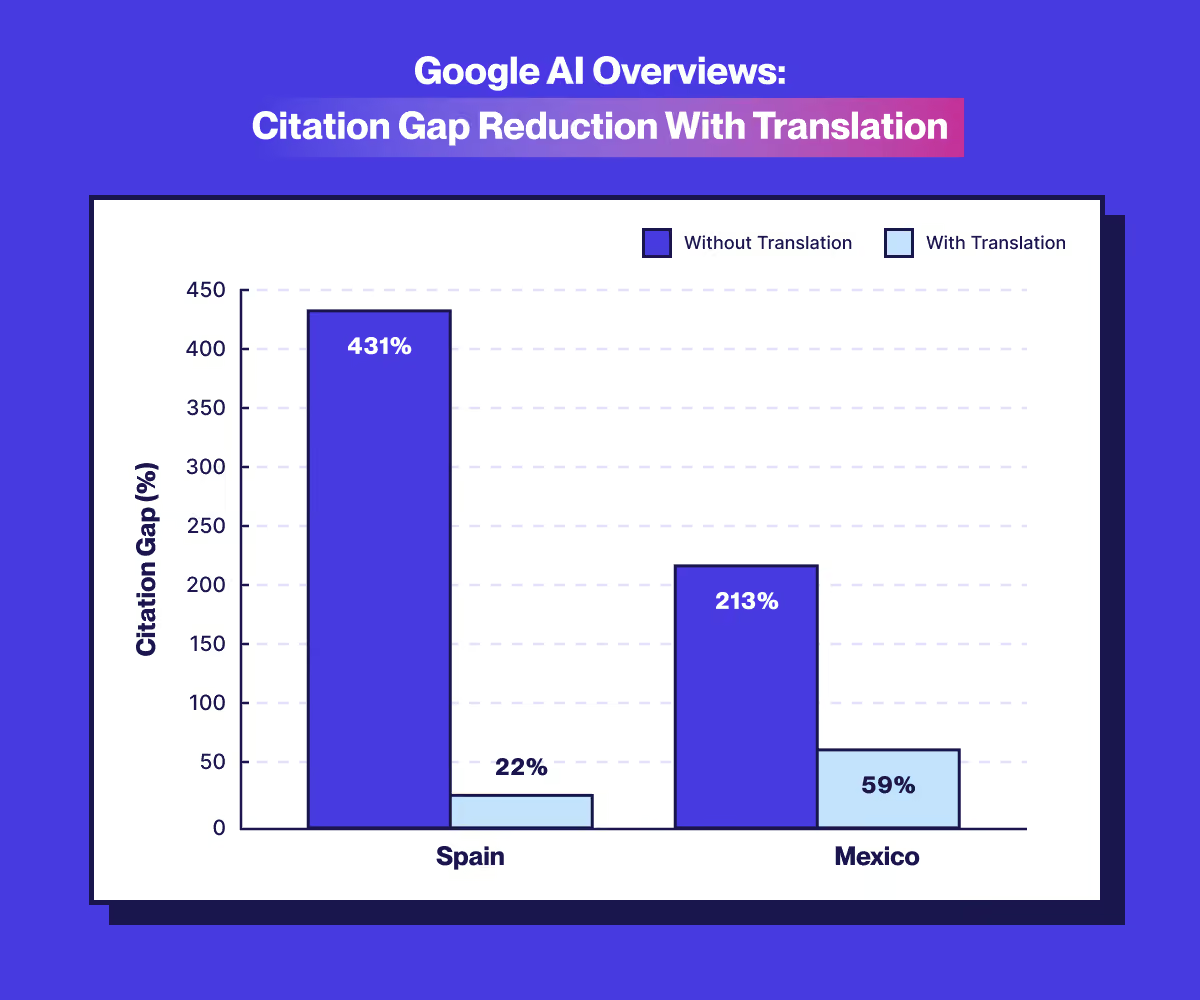
The second phase introduced a comparison group of 83 sites with both Spanish and English versions. The difference was dramatic. Translated sites in Spain achieved 10,046 Spanish citations and 8,048 English citations—a gap of just 22%, compared to 431% for untranslated sites.
Translation boosted visibility for English searches by up to 327%.
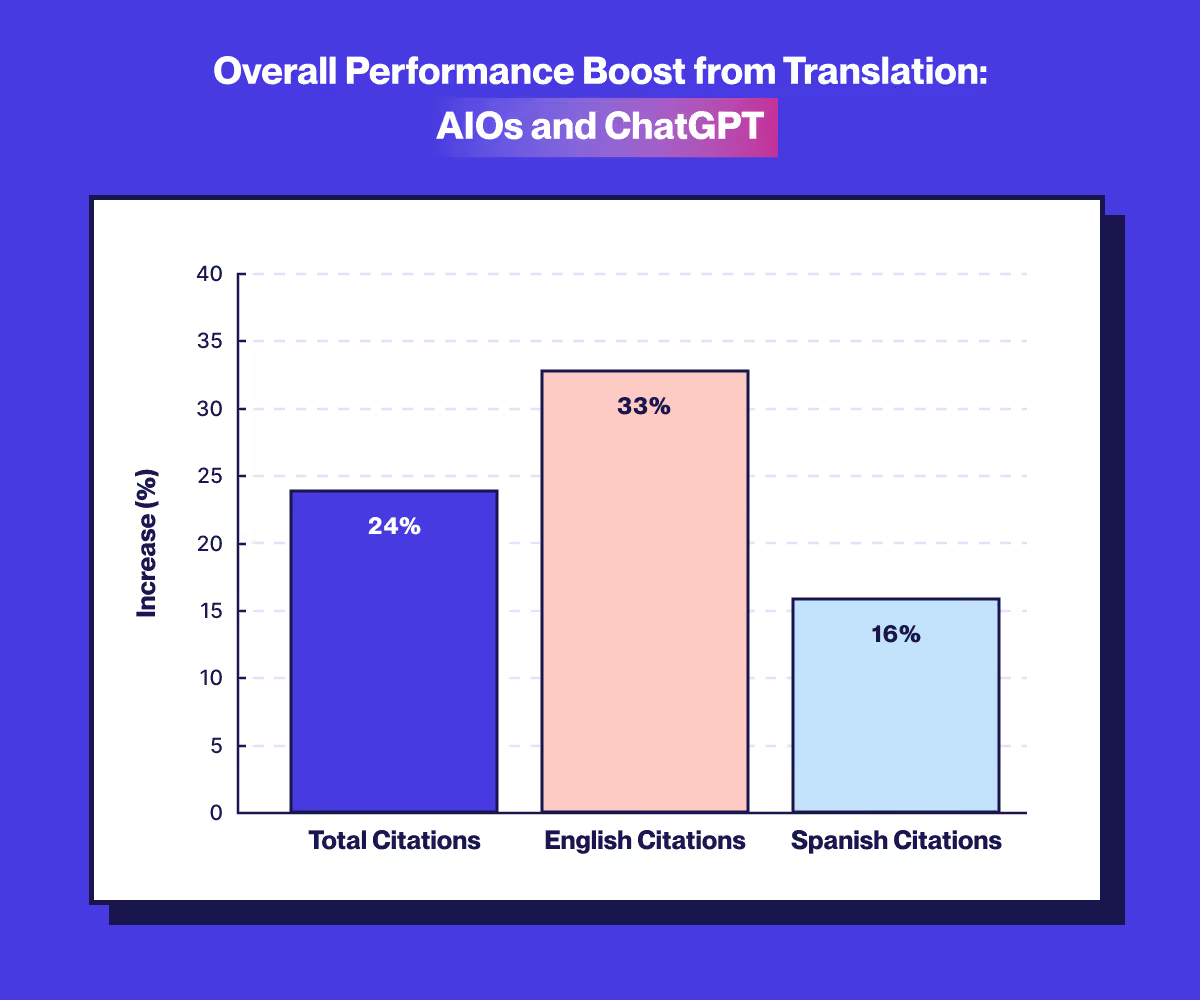
But what surprised us is that translated sites didn't just perform better in their secondary language; they performed better overall. Across both languages, translated sites received 24% more total citations per query than untranslated sites, including a 16% increase in citations for their original Spanish content.
Our hypothesis: translation signals authority and trustworthiness to AI systems. When your content exists in multiple languages, it appears more comprehensive and credible, thereby improving citation performance across the board.
Not all AI search systems behave the same way. Our research revealed meaningful differences in how each platform prioritizes language.
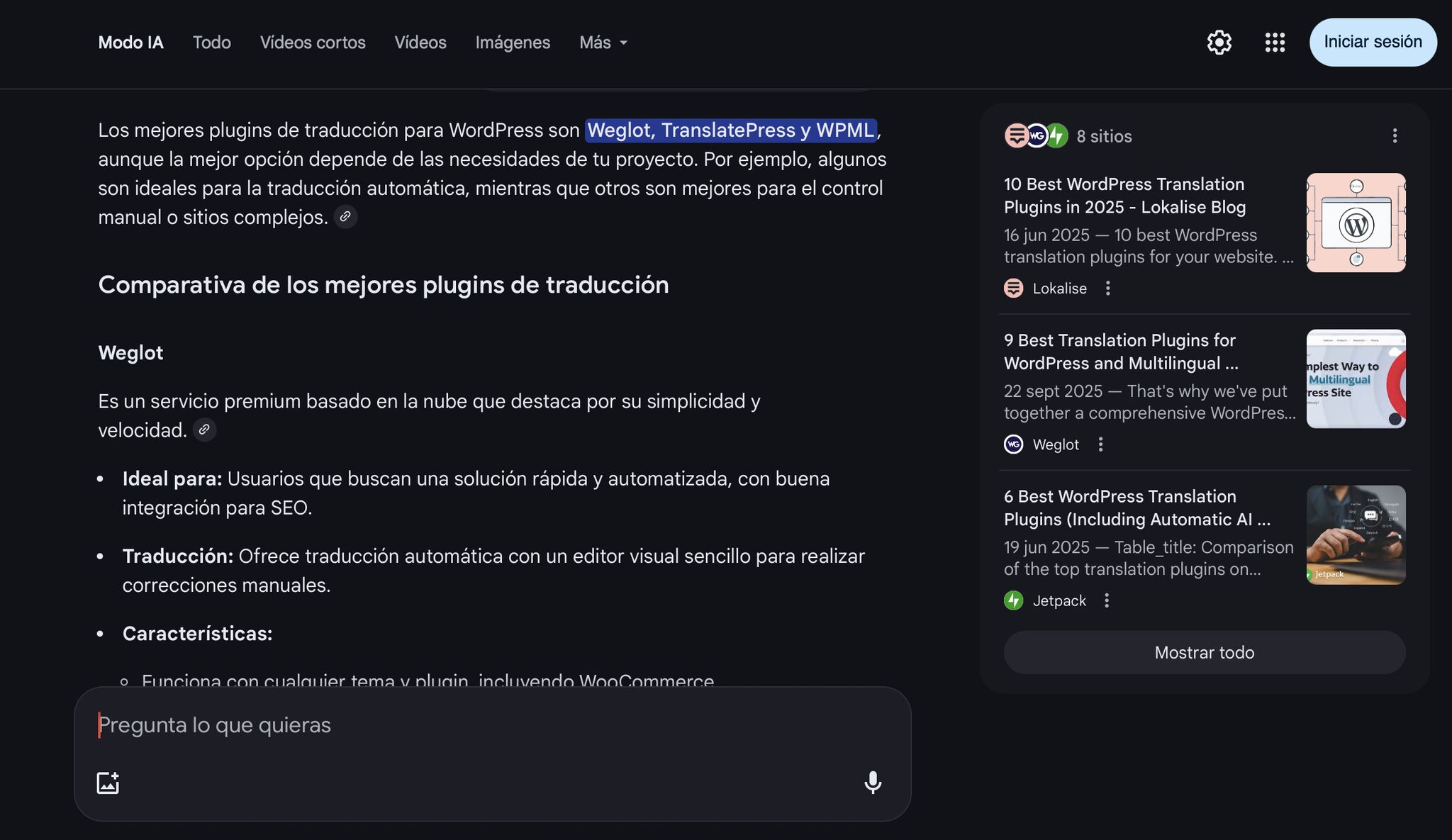
Google AI Overviews proved the most language-sensitive. In our studies using localized queries for the Mexican market, 96% of AI Overview citations came from Spanish sources. When a Spanish-language option existed, English sources were consistently pushed out of the top five positions. AI Overviews also generated shorter, more focused answers, leaning hard into original-language content for contextual relevance.
Google AI Mode behaves differently. It cites roughly 30% more sources per query than AI Overviews but with slightly less strict language prioritization (93% Spanish sources in the same tests). Interestingly, only 55% of queries shared any common cited sources between AI Mode and AI Overviews—sometimes citing entirely different content types for the same query, like a Facebook post in one and a Google Maps listing in the other. These are fundamentally different systems despite living under the same Google roof.
ChatGPT takes a dual-query approach. When a user asks a question in their native language, ChatGPT queries the web twice: once in English and once in the user's language. This makes translated pages critical for appearing in those native-language results. For translated sites, ChatGPT showed virtually no language bias; Spanish sites actually received 0.3% more English citations than Spanish ones. The playing field levels out completely when content exists in both languages.
Perplexity followed similar patterns, primarily citing translated content when available for native-language queries.
Each platform has its own citation logic, but all of them reward content that matches the user's query language.
Given that AI Mode and AI Overviews are both Google products, you might assume they work similarly. They don't—and understanding the distinction matters for your strategy.
Our comparative analysis of 40 localized queries revealed that these systems operate on distinct citation models. Beyond the 55% source overlap mentioned above, the behavioral differences are significant.
AI Overviews prioritizes precision. It favors shorter answers built from fewer, highly relevant sources, with strong preference for original-language content. When Spanish alternatives existed, English sources rarely cracked the top five citation positions.
AI Mode prioritizes breadth. It surfaces more diverse sources (roughly 30% more per query) but with less rigid language matching. This makes it slightly more forgiving for English-only content, but the advantage is marginal.
That means visibility strategies may need to account for both systems. Content optimized for AI Overviews' language sensitivity might perform differently in AI Mode's broader citation approach. But in both cases, translated content outperforms untranslated content, so it's more of a question of degree.
Translation matters, but our research revealed another layer: geography compounds the effect.
We tested 40 queries in both English and Spanish across different locations. In US-based testing (Buffalo and Los Angeles), Spanish-language searches still yielded predominantly English sources, with only about 32% of citations came from Spanish content, even when the query was in Spanish.
But when we ran the same queries through a VPN localized to Mexico City, the picture shifted dramatically. Spanish sources jumped to approximately 63% of citations for Spanish queries.
The implication is clear: AI systems prioritize content that matches both language and geographic relevance. A translated page signals that you serve a particular market. Combined with other localization signals, this creates compounding authority that English-only content simply can't match.
For brands targeting specific international markets, this reinforces that translation is a discoverability prerequisite—not just a UX improvement.
Abstract percentages without actual context don't always land. Here's what visibility gaps look like in practice.
One site in our study was a major Spanish book retailer. They stock English titles, ship internationally, and clearly serve English-speaking customers. But their website isn't translated.
The result: they appear 64% less often in AI Overviews and ChatGPT when the query is in English. For every 100 Spanish queries where they surface, the same query in English shows them only 36 times. Worse, in those 36 cases, the link often goes to Google Translate's proxy—meaning the retailer doesn't even capture the traffic.
We saw similar patterns in a collaborative study tracking nine brands across ChatGPT, Perplexity, and Google AI Overviews. One case stood out: Reviews.io offers a translated website interface in German, but their blog content remains English-only.
The impact was measurable. Over the same period, their English-language monitor showed 41 citations with diverse source pages, while their German monitor showed just 8 citations with no blog articles appearing at all.
Partial translation creates partial visibility. The content you don't translate becomes the content AI can't cite.
If you're targeting audiences who search in languages your website doesn't support, you're leaving visibility on the table. Based on our research, we’ve found that:
Translation is now a visibility strategy, not just user experience. AI systems strongly prefer citing content in the user's query language. Without translated pages, you're excluded from those citations entirely.
Translate your content pages, not just your core site. Blog posts, resources, and educational content drive citations. A translated homepage with English-only blog content creates the same gaps we saw with Reviews.io.
Language and geography signals reinforce each other. Translated content performs best when paired with other localization signals. The combination builds authority that compounds over time.
Different AI platforms, same directional finding. Whether it's AI Overviews, AI Mode, ChatGPT, or Perplexity, translated content consistently outperforms. The magnitude varies, but the pattern holds.
Across 1.3 million citations, multiple AI platforms, and months of research, one finding remained constant: untranslated means invisible.
For marketing managers responsible for international growth, this represents both a challenge and an opportunity. The brands that invest in multilingual content now will build AI search authority while competitors remain locked out of non-English queries.
As AI-powered search continues growing, this visibility gap will only widen.
Ready to make your website visible in AI search across every market you serve? Try Weglot for free for 14 days to see how quickly you can translate your site and start capturing international AI search traffic.

We’ll get your first languages live. You decide how far you want to go. Try Weglot for free today.
Trusted by 110,000+ global brands





Weglot is tested and trusted by brands worldwide since 2016. Join them today.


The best way to understand the power of Weglot is to see it for yourself. Test it for free and without any engagement.
A demo website is available in your dashboard if you’re not ready to connect your website yet.


Language coverage will make the biggest difference. AI search engines prioritize sources that match the query's language, so content that only exists in English rarely gets cited in other languages; in our analysis of 1.3 million citations, translated websites gained 327% more visibility in AI Overviews than single-language sites.
Then make each language version easy to retrieve and cite: give it a dedicated URL, hreflang tags, and translated metadata, and keep translations in sync as your content evolves. Weglot handles that technical layer automatically.
For the full 5-step process, read our multilingual GEO guide.
It significantly helps. In our analysis of 1.3 million citations, websites with translated content saw 327% more visibility in AI Overviews than single-language sites. In another study, an English-only website saw citations drop 80% for queries made in Japanese. That’s because AI engines align citations with the query’s language, and untranslated content rarely gets pulled into non-English answers. Translation gets you onto the candidate list. The rest of GEO (content quality, structure, distribution) determines whether you’re picked from it.
Yes. In our study, asking the same question in a local language rather than English shifted a large share of citations toward local, in-language domains, most dramatically in Japanese.


