Try Weglot for free


We analyzed 1.1 million AI citations across Google AI Overviews, ChatGPT, and Claude.
When someone asks an AI assistant a question, the answer usually comes with sources: links to the websites the AI used to build its reply. These are AI citations, and for a growing number of searches, they’re the new page one.
So we wanted to know whether speaking your customers’ language helps you earn them. With AI search agency Ellipsis, we analyzed 1,136,972 AI citations across Google AI Overviews, ChatGPT, and Claude, asking the same questions in English and Spanish in Spain and Mexico. Then we checked whether each website covered the topic in both languages.
The short answer is that it helps a lot, as long as the content is there in both languages.
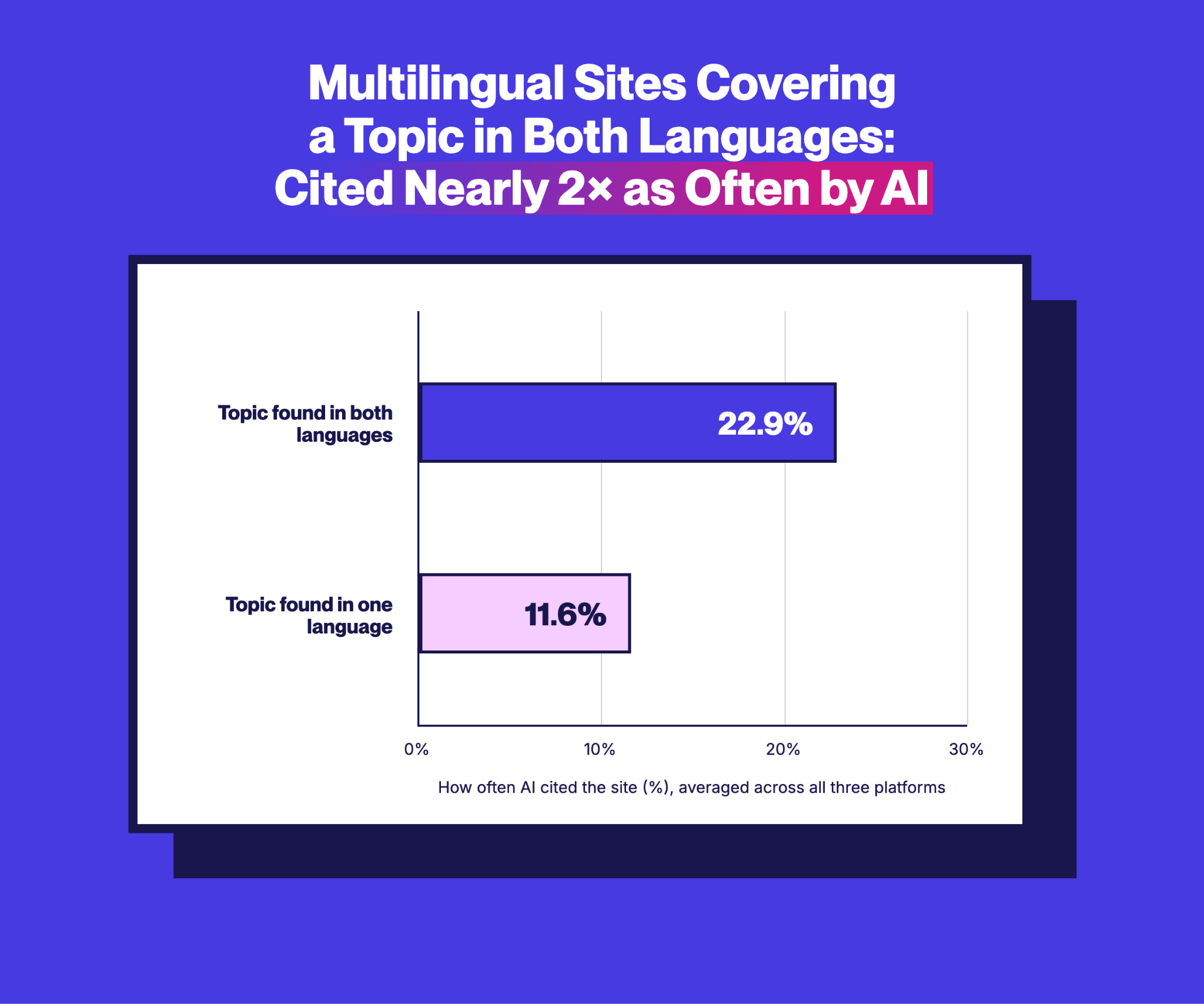
To set a baseline, we looked at how often websites with a topic in only 1 language were cited at all, in either English or Spanish. The answer was not very often: 11.6% on average across the 3 platforms.
When a website covered the same topic in both English and Spanish, that rate rose by 98%. The boost varied by platform:
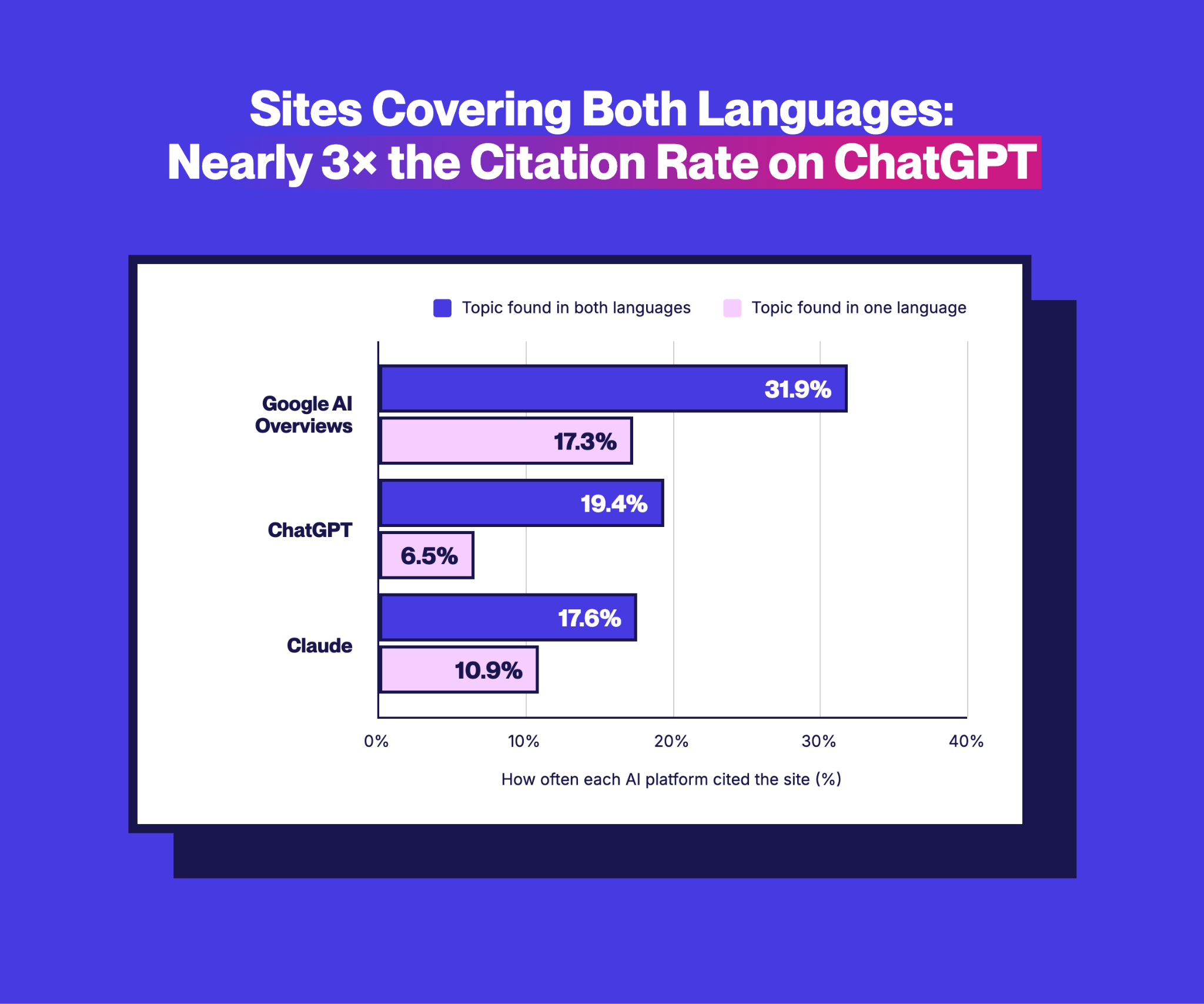
If you remember one finding from this study, make it this one. Websites with a multilingual setup but only a handful of translated pages had, overall, no advantage in AI search.
ChatGPT won’t cite you on a topic because your website has a second language. It cites you because you answer that specific question, in that language. A language switcher on your homepage is a good start, but AI looks at what’s behind it.
We also checked the language of the pages AI linked to. We read the page text itself rather than guessing from the domain, subdomain, or subdirectory, since a .com can host Spanish content as easily as a country domain can host English.
Among links where we could identify the content language, 95% of links from Spanish questions led to Spanish-language pages. For English questions, 77% led to English-language pages.
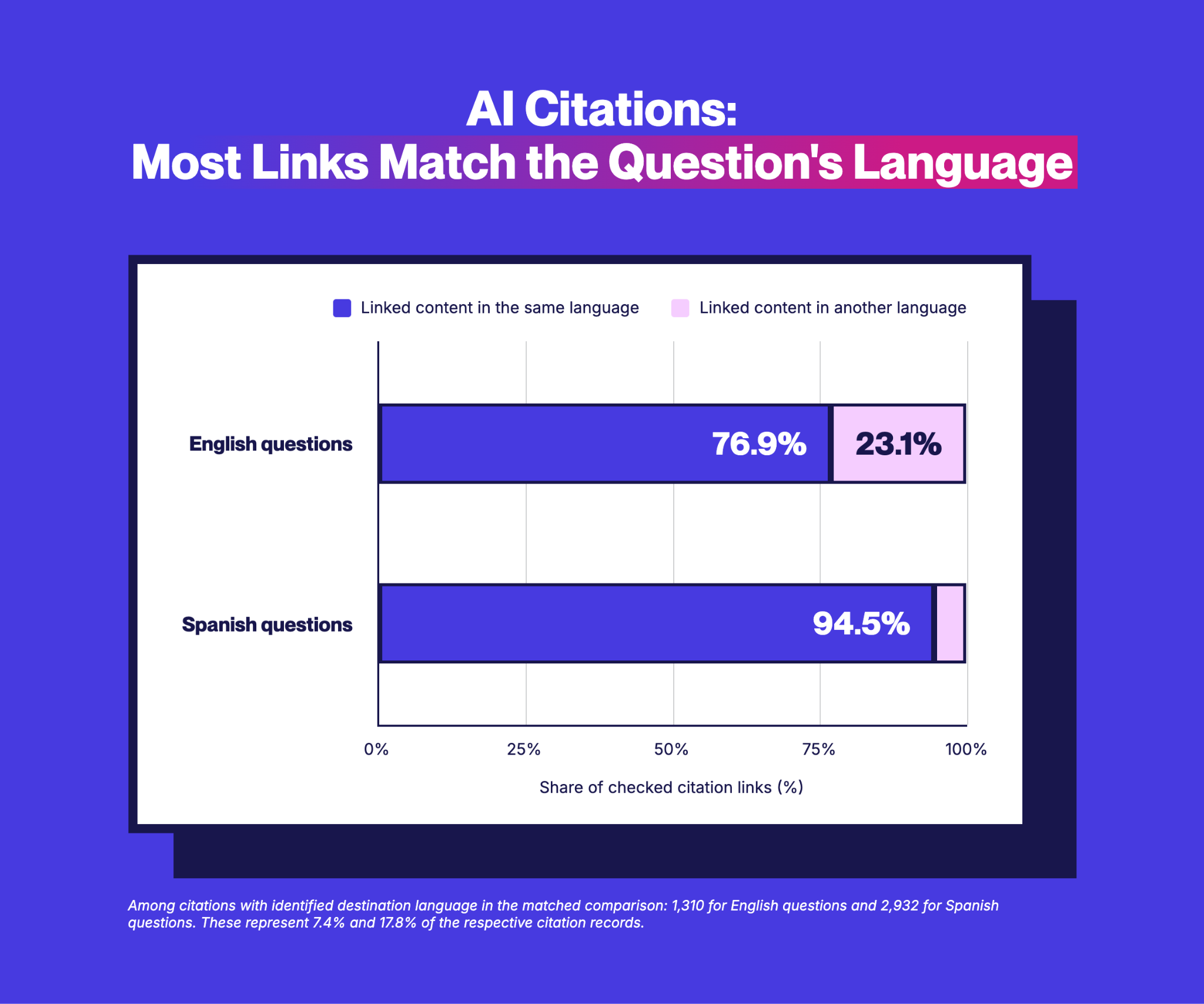
That might sound obvious, but it’s an important data point. Large language models (LLMs) are multilingual, yet they still clearly favor sources in the reader’s own language.
The English questions gave us a useful cross-check: websites covering the topic in both languages were cited 19.7% of the time, compared with 3.1% for websites with Spanish content and no English version.
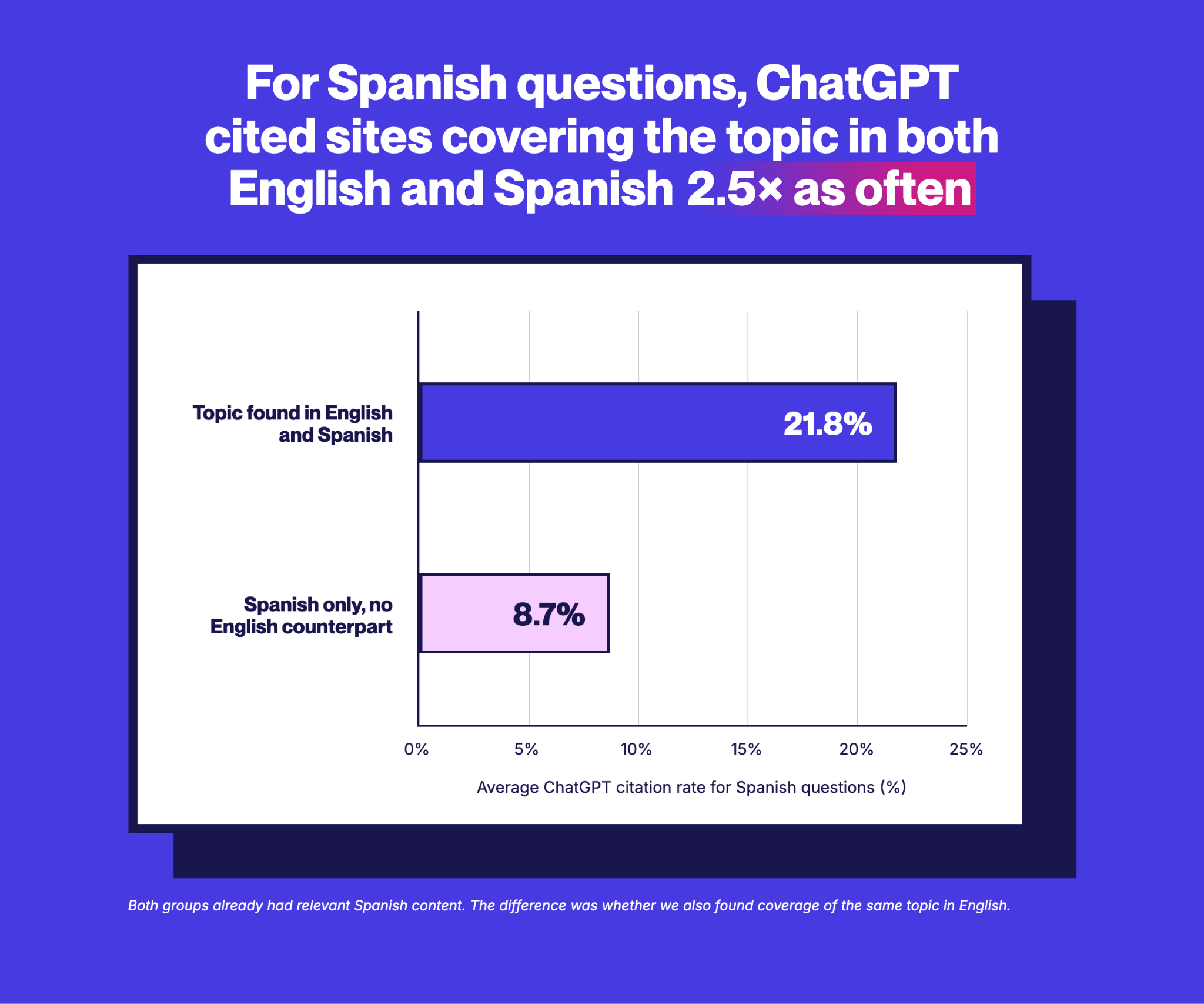
More surprisingly, bilingual coverage helped even when language match wasn’t the difference. On ChatGPT, for questions asked in Spanish, websites that also had English coverage were cited 2.5x as often as Spanish-only websites (21.8% versus 8.7%), although both groups had the Spanish content.
Our 2025 study, also run by Ellipsis on the same websites, covered Google AI Overviews and ChatGPT. Its headline figures came from Google AI Overviews: comparing websites labeled as translated or untranslated, it found up to 327% higher visibility for second-language searches and 24% more citations per question for translated websites.
This year, that website-wide label didn’t tell the same story on its own. It still showed a clear positive link on Claude, but no clear advantage on Google AI Overviews or ChatGPT. So we asked a more specific question: does the website cover the relevant topic in both languages? That’s where the nearly 2x gap appeared.
Our read is that AI search platforms are getting better at judging which content deserves a citation. The takeaway has sharpened too: having a multilingual website still matters, but what counts is making the content your customers need available in their languages.
Generative engine optimization (GEO) is the practice of making your content easy for AI platforms to find and cite. Based on this study, multilingual GEO comes down to depth. A website that’s mostly in 1 language with a few translated pages won’t see the benefit, while full coverage of the topics you want to be cited for will.
A practical way to start:
That way, your translation work goes to the content that earns citations, rather than to having a second language for its own sake.
Weglot can help with the translation side. Our AI translations learn your tone, glossary, and messaging, and you can review and refine them before they go live, so every new language still sounds like you. Our built-in multilingual SEO (translated metadata, hreflang tags, and language-specific URLs) then helps each translated page get discovered.
Ready to cover your key topics in your customers’ languages? Start your free trial.
This study was researched exclusively for Weglot by AI search agency Ellipsis, who also ran our 2025 study.

We’ll get your first languages live. You decide how far you want to go. Try Weglot for free today.
Trusted by 110,000+ global brands





Weglot is tested and trusted by brands worldwide since 2016. Join them today.


0 visits from translated pages in the last 90 days.