Who's winning the market you want to enter?
Enter your domain and a target country. In seconds, you'll see which sites get the most organic traffic there and how many of their keywords you already share.
Your domain
The site you're growing today, and the search terms it already ranks for.
One target country
The market you're weighing up — searched the way people actually search there.
Who's winning there
The sites taking that organic traffic now, ranked by estimated monthly visits.
Where you overlap
Shared keywords show how much of their traffic you're already competing for.
How does the competitor research tool work?
It's a free tool that shows you the competitive picture of a market before you commit to it. You give it your domain and one country; it looks at the search terms your site ranks for, then finds the sites already ranking for those same terms in that country.
Every row is a site you'd be up against if you expanded there, ordered by the organic traffic it gets from that market. Alongside it you see how many terms that site ranks for locally, and how many of them overlap with yours — the clearest signal of whether you'd be entering a crowded market or an open one.
Run it once per country you're considering. The first three competitors are free; enter your email to unlock the full top ten.
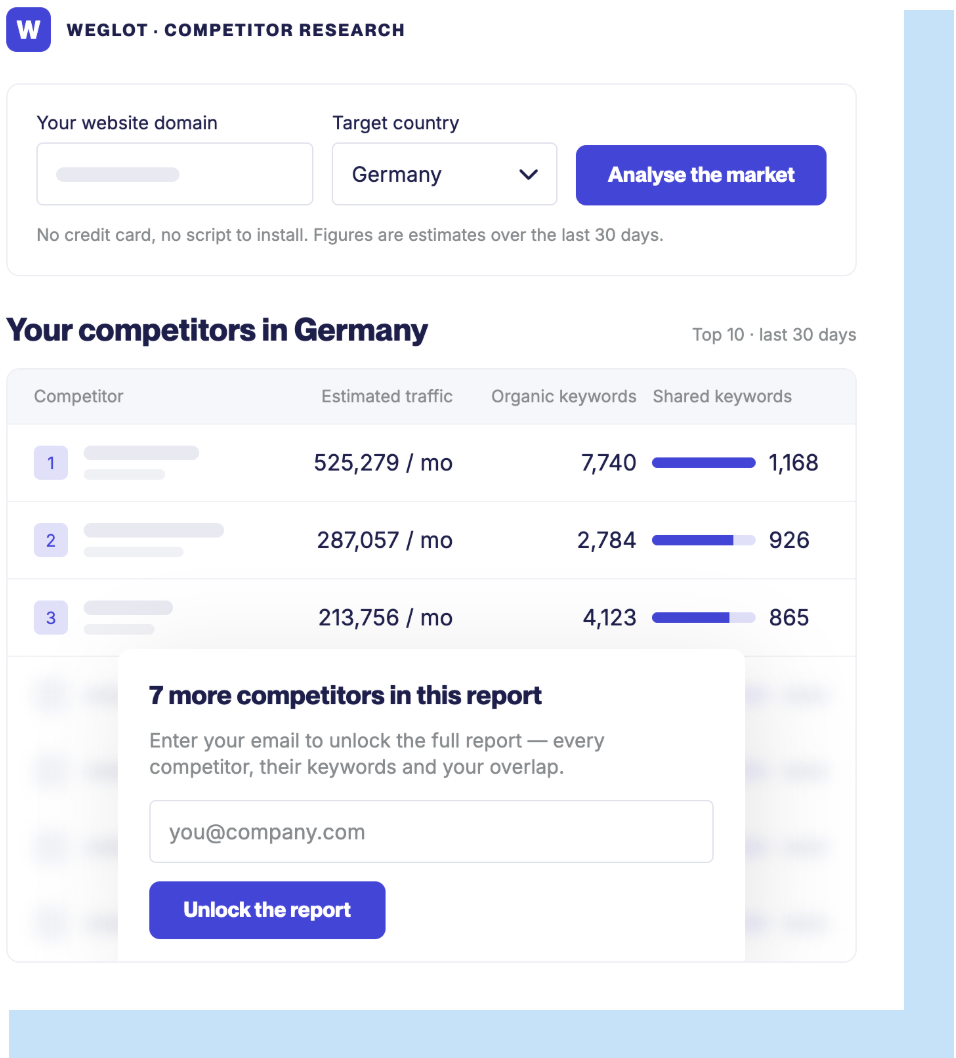
How to read your report
Four numbers per competitor. Together they tell you how much demand exists in the market and how much of it is already taken.
Competitor
The domain ranking in that country. Some will be local players you've never heard of, and those are the useful ones.
Estimated traffic
Monthly organic visits from that country alone. Read it as the size of the prize, not as a precise figure.
Organic keywords
How many local search terms that site ranks for. A high count usually means deep, localized content.
Shared keywords
Terms you both target. The higher the overlap, the more directly you would compete, and the faster translated pages pay off.
You've seen the market. Here's how you enter it
Knowing who ranks is step one. Ranking alongside them takes three things, in this order.
1. Translate your site
You can't win searches in a language your site doesn't speak. Translating your website is what makes you eligible to rank at all, and it's live in minutes with Weglot.
How to translate your entire website2. Localize the keywords
A direct translation of a keyword rarely carries the same volume or intent. Use the shared-keyword list as your starting point, then check local volume before you edit your pages.
3. Get the technical SEO right
Translated metadata, hreflang tags and language-specific URLs are what get your new pages indexed.
See the international SEO checklist
Weglot is free — try now!
Get instant access to Weglot and see how it works for yourself. Keep using it for free, or upgrade when you’re ready to unlock premium benefits.