Try Weglot for free


Shoppers now ask ChatGPT, Gemini, and Google’s AI Mode which running shoes to buy, which serum suits sensitive skin, and whether a brand ships to Italy. They ask in Italian, Japanese, and Portuguese too, and the answer they get depends on what the AI can find in that language.
To get your Shopify store recommended by AI search in multiple languages, make sure AI crawlers can reach your store and publish a complete, indexable version of it in each language, with its own URL, hreflang tags, and translated metadata. Then fill each version with accurate product details and answers to buying questions, and test the prompts your customers would type in every market.
A Shopify store can reach an AI answer in 2 ways.
The first is Shopify Catalog. Shopify sends eligible products to AI channels like ChatGPT and Microsoft Copilot with their title, description, images, price, and availability, all structured so AI agents can read them.
Google AI Mode and Gemini get your products through the Google and YouTube sales channel.
As for ChatGPT, international stores have to play by a different set of rules. Shopify’s requirements for selling on ChatGPT state that your store must sell to customers in the United States (it can be based elsewhere).
The second route is the open web. Shopify’s own documentation notes that AI channels also discover products through regular web crawling and indexing. ChatGPT search relies on OpenAI’s search crawler. Meanwhile, for a page to appear as a supporting link in AI Overviews or AI Mode, Google says that it only needs to be indexed and eligible for a snippet.
For a store selling in several languages, the open web does a lot of the heavy lifting, because AI search answers in the language it’s asked in and goes looking for sources in that language. In Weglot’s cross-country study, French-language questions sent 16% of citations to .fr domains, against 1.4% when the same questions were asked in English. Ecommerce questions also pulled more sources than most topics (4.09 per query on average across ChatGPT, Claude, and Gemini, against 0.94 for tutorials), so shopping prompts are where citations are most up for grabs.
In practice, if your French product pages don’t exist, can’t be crawled, or are half in English, they aren’t in the pool AI draws from when a shopper asks in French.
AI search can’t recommend a page it can’t read. OpenAI uses a crawler called OAI-SearchBot to surface websites in ChatGPT search. Sites that block it won’t appear in ChatGPT search answers beyond navigational links. It’s separate from GPTBot, which collects training data, so you can block GPTBot and still allow OAI-SearchBot.
On Shopify, crawler rules are written into your theme’s robots.txt.liquid template. Check that neither your theme nor a bot-blocking or SEO app disallows OAI-SearchBot, Googlebot, or the other AI search crawlers you want to appear in, and that your language folders (like /fr/ or /de/) aren’t excluded. Shopify points out that these rules only affect open-web discovery; it doesn’t impact the product data Shopify Catalog sends to agentic storefronts.
Shopify also serves /agents.md and /llms.txt files on every store automatically, so you don’t need an app to create them. While they summarize your store for AI agents, they don’t replace crawlable, indexable product pages.
Every language version needs its own address, such as yourstore.com/fr/, fr.yourstore.com, or yourstore.fr, so it can be crawled, indexed, and cited. Google recommends distinct URLs for each language and advises against switching languages with cookies or browser settings alone. Crawlers usually don’t send language preferences, so a version that only appears through cookies or browser settings may never be crawled or indexed.
If you’re weighing the options, our guide on whether you need a separate domain or subdomain per language compares each.
Next, connect the versions with hreflang tags, which tell search engines which language and region each page targets. Shopify adds hreflang tags automatically by default and suggests turning them off if a theme or app adds its own, so you don’t end up with duplicates. Our Shopify hreflang guide covers setup and the most common mistakes.
Finally, translate your SEO titles and meta descriptions. They’re what appears in search results, and an English meta description on a German product page sends a mixed signal about which language the page serves. Our guide to Shopify titles and meta descriptions has examples.
Weglot takes care of this entire step for you. It creates language subdirectories or subdomains, adds hreflang tags, and translates your metadata automatically, and it’s compatible with Shopify Markets. URL slug translation is available on Pro plans and above.
Picture a German product page where the description is translated, but the reviews, size chart, shipping banner, and cart drawer are still in English. Google’s multilingual guidance asks for one clear language per page; if a regular shopper gets confused by this half-translated page, so will the AI systems reading it.
Content that tends to slip through the translation tracks are:
Coverage matters for AI visibility specifically. In Weglot’s 2026 study, websites covering a topic in both English and Spanish had a 98% higher AI citation rate than websites covering it in 1 language, while websites with a multilingual setup but only a handful of translated pages had no overall advantage. An earlier Weglot analysis of 1.3 million citations found that translated sites got up to 327% more visibility in Google AI Overviews for searches in their second language.
When you choose or audit your translation setup, check 3 things:
Weglot reads your storefront’s HTML instead of only Shopify’s translatable fields, so third-party app content and dynamic elements are part of the same translation project. New content is detected and translated automatically as you add it. Our article on whether AI can translate your entire online store goes deeper.
AI assistants recommend products by matching details to a request like “waterproof hiking boots with a wide fit under €150”. Shopify lists the fields AI platforms consider, including title, description, images, product type, tags, barcodes, and variant options. In a multilingual store, those details need to be accurate in each language, not only present.
The same applies to structured data. Most Shopify themes add product markup (name, price, availability) that Google reads for merchant listings, so check that it appears on every language version with the name and description translated.
Translation tends to go wrong in predictable places:
A glossary fixes the first and third problems: you define once how a term is translated (or that it never is), and the rule applies everywhere. For your highest-revenue pages, review translations in context and bring in a human reviewer where accuracy matters most. Our guide on how to localize your Shopify store with AI covers that workflow, and we’ve also compared the most accurate AI translation tools for business websites.
Weglot’s AI translation can be refined with a Glossary and Translation Exclusions, and the Visual Editor lets you edit translations on a live preview of your store. Media translation lets you display localized images and videos on each language version.
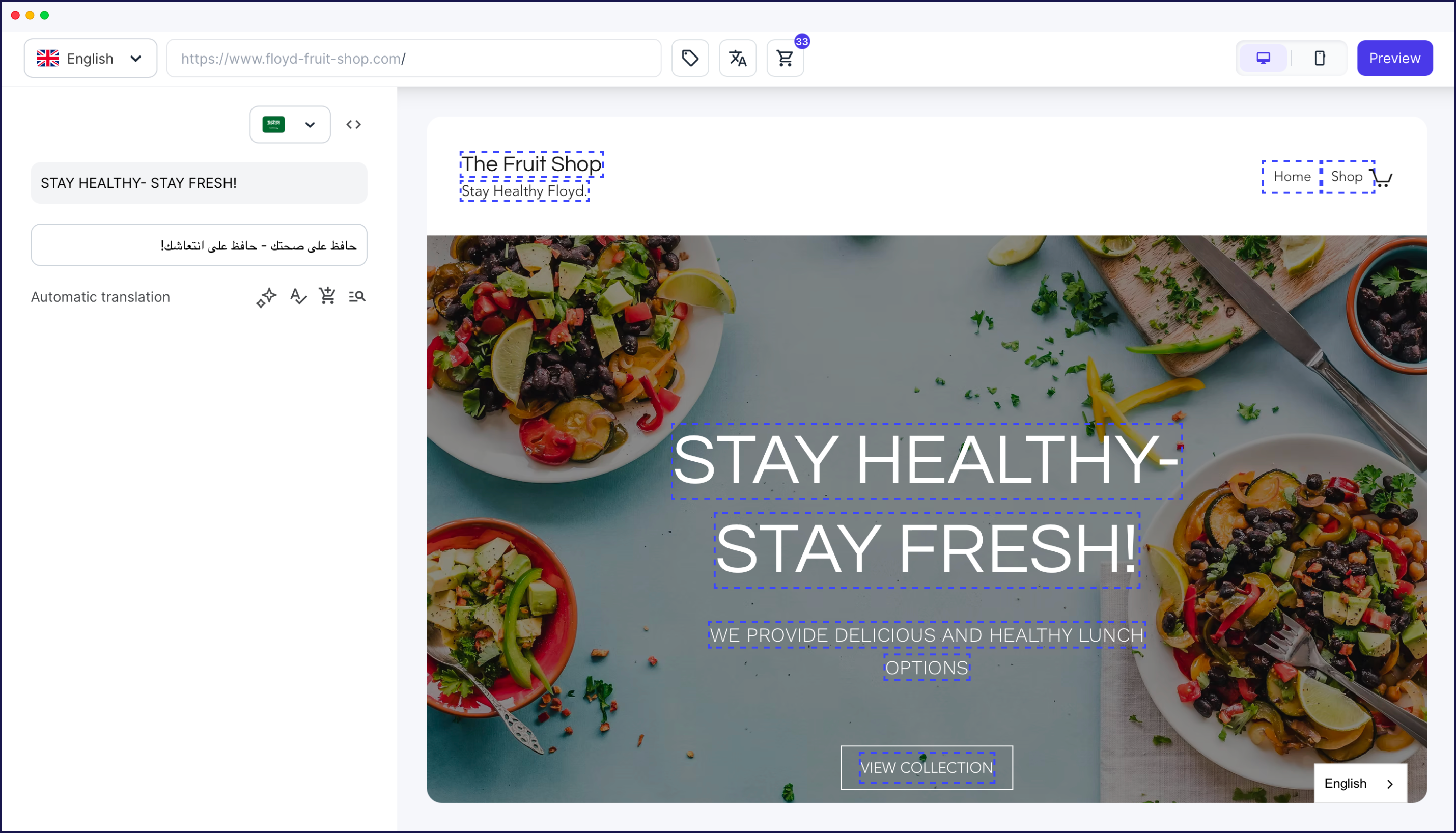
Shopping prompts rarely stop at the product. Shoppers ask whether you ship to Spain, how returns work, and which size to pick, and AI agents answer from what your store publishes. Shopify notes that complete store policies help AI agents give the right answer when a customer asks about returns.
Translate your shipping, returns, size guide, FAQ, and About pages into every language you sell in. Then add the local details that differ by market, such as delivery times, duties, and payment options.
Which pages get cited also depends on the AI system. Weglot’s cross-country study found that Claude sent nearly 9 in 10 citations to commercial and brand pages, while YouTube and Reddit made up 21.5% of Gemini’s citations and 29.8% of Google AI Overviews’ citations. Your own store pages matter most for ChatGPT and Claude; for Gemini and AI Overviews, local-language videos and community discussions help too.
Visibility in English doesn’t predict visibility in German, so test each market separately. Write 10–20 prompts a customer would ask, adapt them into each language (localized, not translated word for word), and run them in ChatGPT, Gemini, Google AI Mode, and Perplexity. Note whether your store is named, whether it’s linked, and which page gets cited.
Make your test prompts specific. In Weglot’s study, ChatGPT cited 0.09 sources on average for short, general questions and 2.26 for long, specific ones, so “best moisturizer” tells you far less than “best fragrance-free moisturizer for dry skin that ships to Belgium”.
To track traffic, ChatGPT adds utm_source=chatgpt.com to referral links, so you can filter AI referrals in your analytics and break them down by language folder (/fr/, /de/). Our guide to international SEO and GEO metrics covers what else to track.
For citation monitoring by language, Weglot Radar shows where you’re cited, and where you’re missing, across ChatGPT, Google AI Overviews, Perplexity, Gemini, and Claude.
AI search can recommend your store to a shopper in Spain or Japan only if there’s a complete, crawlable Spanish or Japanese store to find. Weglot translates your whole Shopify store, app content included, and handles the language URLs, hreflang tags, and translated metadata, so each version is ready to be indexed and cited.
Ready to make your Shopify store multilingual? Weglot offers a 14-day free trial. Start your free trial.

We’ll get your first languages live. You decide how far you want to go. Try Weglot for free today.
Trusted by 110,000+ global brands





Weglot is tested and trusted by brands worldwide since 2016. Join them today.


0 visits from translated pages in the last 90 days.


No. Eligible products are discoverable through Shopify Catalog without extra setup, and ChatGPT search can also cite storefront pages its crawler has visited. Selling inside ChatGPT currently requires that your store sells to customers in the United States, so in other markets, your crawlable pages in each language matter most.
Google’s guidance on generative AI content focuses on whether content is helpful and accurate, not on how it was produced. Mass-producing pages that add no value is what runs into its spam policies. Use AI translation as your starting point, set glossary rules, and review your highest-traffic pages.
Start with the markets where you already see traffic or orders, which your analytics can break down by country and browser language. Weglot’s research found that a thinly translated second language brings no citation advantage, so translate each language you add fully before spreading a light layer across many.
Yes, Weglot is compatible with Shopify Markets. Stores using Markets run on language subdirectories, and Weglot’s support team helps with the URL routing setup.