

Try Weglot for free





Translation accuracy is about meaning. It’s how closely your translated page triggers the same understanding and action as the original text – without adding, losing, or twisting anything important.
That’s why ‘95% accurate’ reads very differently from ‘around 70% accurate’ content in practice. At 95%, most sentences land as intended, the brand voice feels familiar, and only edge cases need a second look. At 70%, confusion, odd phrasing, and silent customer drop-offs start to pile up, especially on product and checkout pages.
In this article, you’ll see what lives inside that 25% gap. We’ll detail how it affects trust, conversions, workload, and how an AI Translation Model helps you operate safely in the 90-95% range while keeping human control where it matters most.
When we talk about 95% vs 70% translation accuracy, we’re not quoting a magic universal score. These figures are based on a joint Weglot and Nimdzi insights study on website and marketing content.
{{ebook-banner}}
In the State of Machine Translation for Websites study, 5 leading Machine Translation (MT) providers (Amazon Translate, DeepL, Google Cloud, Microsoft Translator, and ModernMT) were tested across 6 language pairs.
They covered 168 segments and more than 1,000 words from American English into French, German, Spanish, Simplified Chinese, Arabic, and European Portuguese.
Professional linguists rated each translation for usability and accuracy. 85% of the 14 engine-language combinations were scored as ‘Very good’ or ‘Acceptable’, and none were rated ‘Very bad’. For German, 145 of 168 segments required no edits at all, while Portuguese sat at the other end of the spectrum with 58 untouched segments (no human editing required).
So where does 95% come from? In high-resource language pairs and straightforward marketing copy, state-of-the-art neural MT now delivers output that professional reviewers treat as usable in the large majority of cases.
Meanwhile, 70% accuracy means having content or language pairs where roughly 3 in 10 sentences need real human intervention. Even in the Weglot/Nimdzi data, linguists still edited a meaningful slice of output, and across our customer base we see about 30% of AI-translated content being touched up post-translation.
This matters, because it highlights two uncomfortable truths. No translator – human or AI – delivers 100% perfection, and AI works best when you treat it as a high-speed first draft, rather than a replacement for human judgment. This is exactly the assumption our website translation tool is built on. Weglot gives you high-quality AI translations by default, then lets you review and refine them in context so you stay in that safer 90-95% band on the pages that matter most.
{{ai-banner}}
What pushes a translation closer to 95% or drags it toward 70% is a set of variables you can usually spot in your own content before you translate.
Human translators are strongest on context and cultural nuance. They read tone, intention, and subtext, then rewrite so it sounds natural.
AI translation optimizes for speed and coverage. It’s ideal for large catalogs, long-tail content, and routine updates that would overwhelm a small team.
A hybrid workflow combines both. AI handles the volume, and humans focus on high-stakes pages like legal content, key campaigns, and checkout flows.
For a deeper dive, read our article on Human vs Machine Translation.
Some language pairs are easier to translate than others. English-Spanish, English-French, or English-German share alphabets and similar structures, and have huge training systems. Quality here usually lands nearer the 90-95% range.
Pairs like English-Chinese, English-Arabic, or English-Japanese involve different scripts, syntax, and ways of encoding politeness. Those differences pull raw output closer to 70% unless you add review.
When you pick markets, you’re also picking your likely editing workload. ‘Closer’ languages usually mean less post-editing. ‘Distant’ languages need more attention on critical pages.
General marketing copy and product descriptions are AI-friendly. The language is common and the risk of a slightly stiff sentence is low.
Legal, medical, and financial content is a different story. A single mistranslated clause, dosage, or term can cause real damage. Those pages belong in human or hybrid workflows with professional translators.
A quick test – if this page is wrong, do we lose a sale or create a liability? If it creates a liability, keep humans in the loop.
Generic content (‘Free shipping over €50’) is easier to render accurately. Highly branded lines, wordplay, and cultural references are harder.
Static pages (About, evergreen FAQs) let you refine once and enjoy 95%-level quality over time. Constantly changing content (daily product updates, promos) leans more on AI and smart rules, with selective human review where confusion would really hurt.
Weglot aligns with these factors by combining fast, scalable AI translation with optional human and hybrid workflows. You can prioritize accuracy where it matters most while maintaining coverage across large or frequently updated content. Performance naturally varies based on language pair complexity, content risk, and brand nuance, but high translation accuracy plus built-in editing tools push quality to the high end over time.
You can even order professional translations directly through the Weglot dashboard, for extra speed and added convenience.
{{quote-cta-banner}}
You can measure translation accuracy in 2 broad ways – automated scores and human-style checks. For a website owner, the second group is usually more useful than any single number.
BLEU is the classic metric. It compares n-grams in the machine translation to one or more human reference translations on a 0-100 scale. In real use, a BLEU score somewhere around 40-60 is often associated with high-quality output for common language pairs and domains. However, BLEU correlates only loosely with human judgment and can reward ‘safe’, literal phrasing that still feels awkward to a reader.
COMET is the modern alternative many researchers prefer. It uses neural models to judge how well a translation preserves meaning and fluency, and tends to align better with human ratings than BLEU. METEOR is another legacy metric that tries to improve on BLEU by considering synonyms and stemming, but it’s less central in current MT research.
“For professional evaluation, MQM (Multidimensional Quality Metrics) is the standard human framework. Reviewers categorize errors (accuracy, terminology, fluency, style, etc.), assign severities, and produce a structured score you can track over time. It’s rigorous, but heavy for an SMB marketing team that just wants to know if a product page is safe to ship.”
– Eugène Ernoult, CMO at Weglot
In practice, you get more value from lightweight, repeatable checks:
For most SMBs, practical checks on a small, high-impact slice of pages tell you far more about accuracy than any automated metric.
Measuring accuracy is helpful, but you only feel the difference between 70% and 95% once you bake it into a repeatable QA process for your site. Here’s a workflow that actually works at website scale.
Use Translation Memory (TM) to reuse proven segments across your catalog so statements like ‘Free returns within 30 days’ don’t get reinvented 12 different ways. Glossaries lock in product names, feature labels, and brand terms, so those stay consistent even as thousands of lines pass through AI.
The catch is that TM happily repeats mistakes. Make time to audit and clean it – especially early on – because one bad stored sentence will quietly propagate to every matching page. When you correct an error, push that fix back into TM.
As we’ve seen, not all content deserves the same workflow. General marketing and ecommerce copy can go through AI-first translation plus focused review. Legal terms and conditions, medical guidance, and complex technical documentation should go to subject-matter expert translators, not generalists.
Create simple routing rules. For example, privacy policy, contracts, and compliance pages should always go to your legal language partner; dosage information or clinical claims always go to medical specialists; and intricate product specs go to technical reviewers. That way, you don’t rely on someone catching errors at the last minute.
A solid QA loop has 3 distinct passes:
Don’t run all 3 levels on every line, but apply the full stack to critical templates and top-converting pages.
Language behaves differently on a live page than in a cell. Wherever possible, review translations inside your website layout, with images, buttons, and forms visible. You’ll spot line breaks, overflowing headings, and CTAs that feel too long or too blunt in context.
“While you’re there, look beyond literal correctness. Check cultural fit – are examples, references, and tone appropriate for that market? A technically accurate sentence that feels cold, rude, or awkward to local readers belongs closer to 70% than 95%, even if every term is technically correct.”
– Eugène Ernoult, CMO at Weglot
The practical way to move more of your website toward the 90-95% band is to run a hybrid workflow like Weglot where AI handles the heavy lifting, and humans focus where they add the most value.
It starts with AI translation as your default. Your site content is detected automatically as you publish or update pages, then translated across all chosen languages in one pass. That gives you full coverage – product pages, collection pages, blog posts, navigation, and metadata – without having to copy-paste strings into files or spreadsheets.
You then layer in a brand-trained AI Translation Model. It learns from your glossary, brand rules, and custom rules, so future output gets closer to how your team actually writes.

Over time, that directly tackles the brand voice and terminology variables that usually drag accuracy down, especially on marketing pages and product detail copy.
From there, you move into human-friendly review, but without forcing marketers to think like linguists. Weglot’s Visual Editor lets non-technical teammates review translations in context, directly on the page.
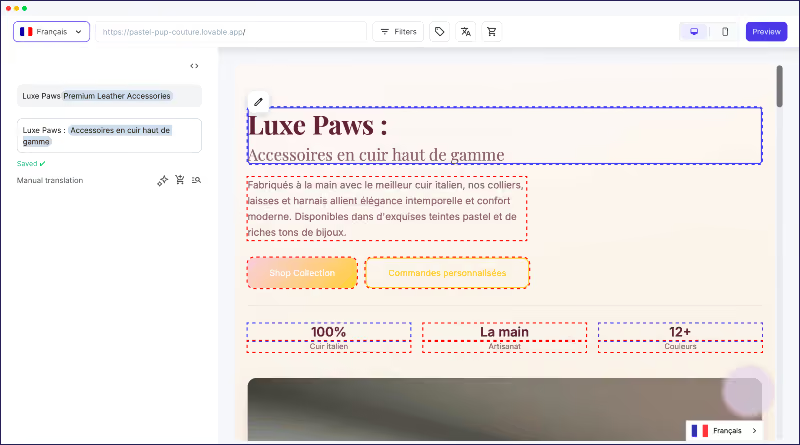
They can see how a headline fits in a hero section, how long a CTA looks on a button, or whether a line sounds too formal once it sits next to imagery and forms. That in-context view is where you catch the cultural and UX issues that pure accuracy metrics miss.
For high-stakes content – legal pages, key funnels, regulated industries – you escalate to professional translators or subject-matter experts. They work on top of the AI draft, not from scratch, so you keep the speed advantage while still matching the scrutiny these pages need. This is where you intentionally push quality well past ‘good enough’ because the risk of confusion is higher.
Once this pipeline is in place, automatic content detection keeps everything in sync. New products, changed headlines, or updated FAQs are picked up, translated, and re-scored by your AI Translation Model, with your rules and past edits baked in. AI gives you coverage and speed. Glossaries, brand training, and in-context review protect voice and nuance; and targeted human review closes the last gap on the pages where accuracy really cannot slip.
{{demo-banner}}
You don’t have to guess whether your site sits closer to 70% or 95% accuracy – you can measure it on your own content. With Weglot’s AI Translation Quality Checker, you paste a URL, choose a language pair, and get a real accuracy estimate based on the pages your customers actually see.
{{tool-banner}}
Use the framework from this article as you review the results. Look at language pairs, subject matter, brand voice, and how often those pages change. Then decide where you’re happy with AI on autopilot and where you want extra human review.
When you’re ready to see what this looks like in action, start a 14-day free Weglot trial and test AI translation accuracy on your own website today.

We’ll get your first languages live. You decide how far you want to go. Try Weglot for free today.
Trusted by 70,000+ global brands








Weglot is tested and trusted by brands worldwide since 2016. Join them today.


The best way to understand the power of Weglot is to see it for yourself. Test it for free and without any engagement.
A demo website is available in your dashboard if you’re not ready to connect your website yet.
